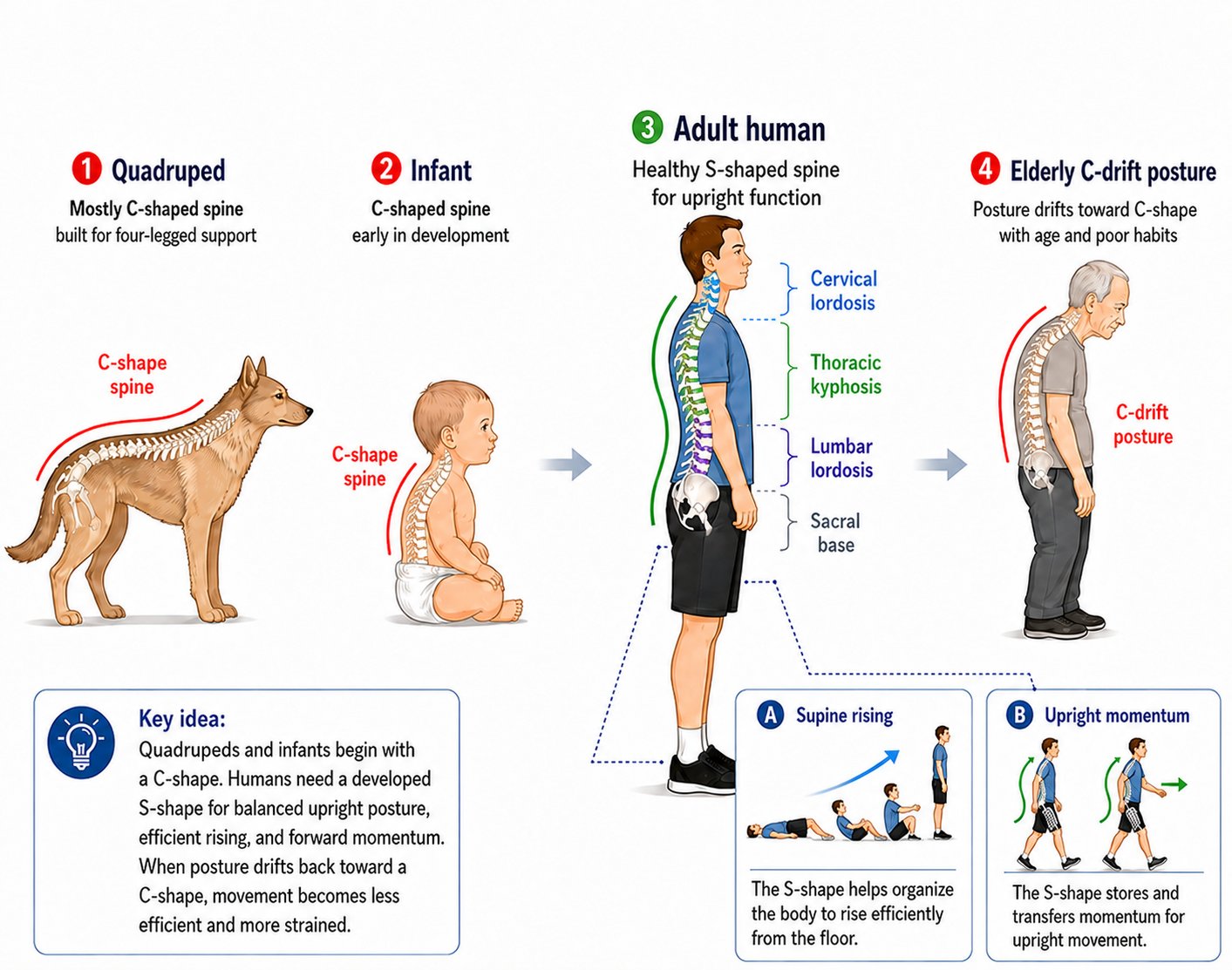

Chapter 20 of my book Spinal Fitness sets out a 4-part recovery model: structure, cellular energy, detoxification and mineral balance. Spinal Fitness training covers the first part. The other 3 cover the living tissue the training works on.
Why a spine book has a recovery chapter
The chapter’s premise is that a body that is metabolically depleted may struggle to sustain structural progress in the spine even when the mechanical correction is right. A person can perform the right movement, use the right support and understand the right posture, and still recover slowly because the cells lack the resources to rebuild and hold the adaptation. Corrective exercise supplies the mechanical stimulus; mineral balance determines whether the body has the resources to adapt to it.
The 4 parts, as the book defines them
Part 1, structure: restore the spinal curves, improve alignment, reduce harmful shear, regain segmental control and move from better mechanical advantage, through Spinal Fitness training, the PowerCushion, corrective exercise and postural retraining. Part 2, cellular energy: repair requires ATP, and red and near-infrared light, heat, oxygen, circulation, minerals, protein, sleep and appropriate pacing all support cellular energy production. Part 3, detoxification: the body eliminates metabolic waste, inflammatory byproducts and, where present, accumulated toxic metals through sweating, hydration, bowel function, liver support, minerals and clean air. Part 4, mineral balance: bones, muscles, nerves, fascia, adrenal and thyroid function, cell permeability and detoxification all depend on it.
Light and heat: the Sauna Fix
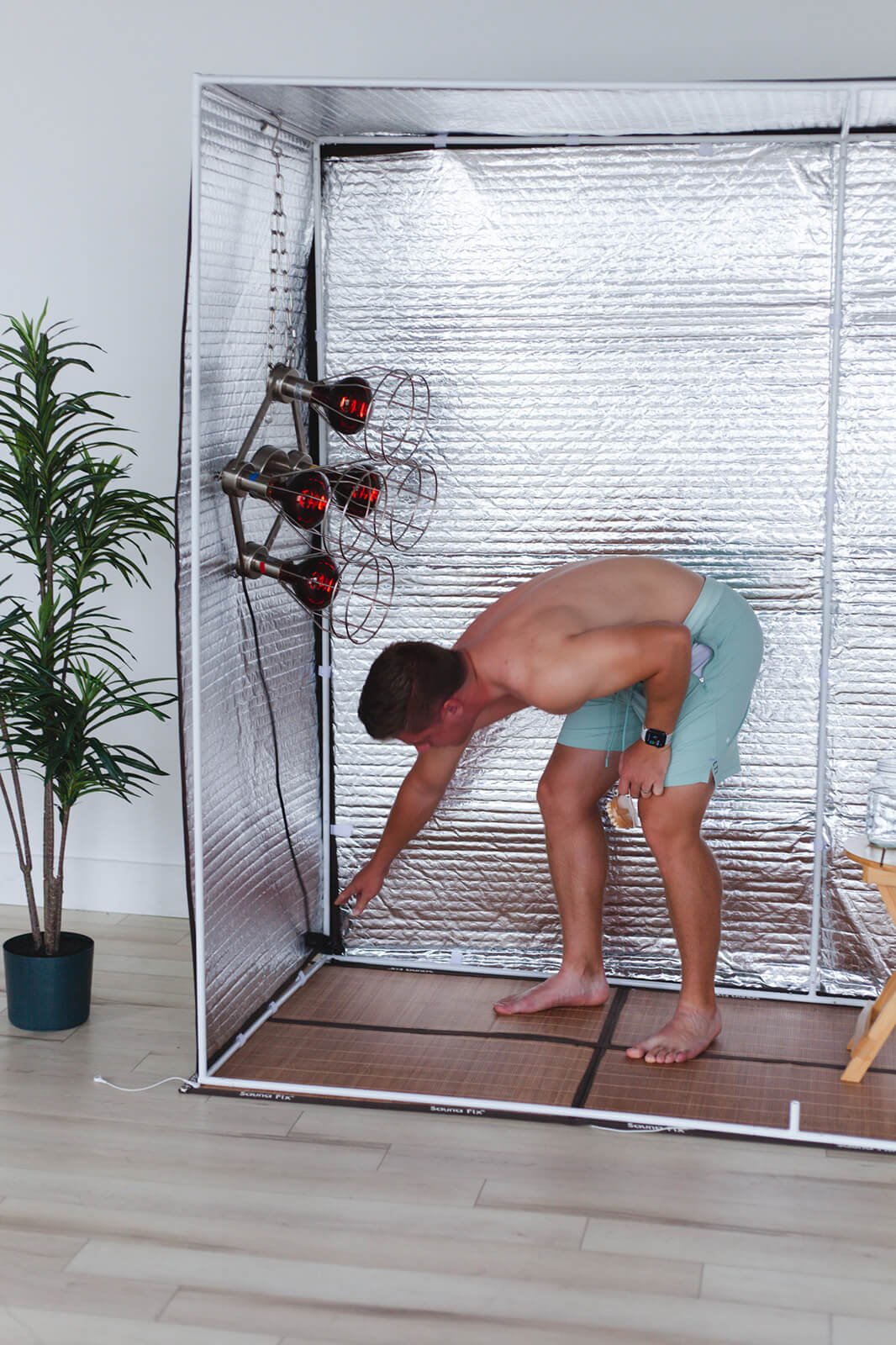
The Sauna Fix is a full-spectrum incandescent sauna that delivers visible red light, near-infrared light, mid-infrared and far-infrared heat from the same incandescent source. The book’s recovery principle for it is photobiomodulation: specific red and near-infrared wavelengths interact with cytochrome c oxidase, an enzyme in the mitochondrial electron transport chain involved in oxygen consumption and ATP production, and near-infrared light may help the cell produce energy more efficiently. Red light primarily reaches superficial tissue such as skin and surface circulation, and near-infrared light penetrates more deeply into muscles, fascia, joints and nerves.
Heat widens blood vessels and increases blood flow to muscles, fascia and joints, and it stimulates heat shock proteins, the protective cellular stress-response molecules that assist protein folding and cellular repair. The book cites a review in Mayo Clinic Proceedings that summarized evidence linking sauna bathing with increased heart rate, vascular effects and relaxation responses, and it presents sauna heat as a way to raise circulation and cardiovascular demand for a person who cannot yet exercise intensely, without loading the spine.
For timing, the book places a short pre-training session of 10 to 15 minutes at a comfortable intensity to warm muscles and fascia, reduce morning stiffness and prepare the body for corrective movement. After training, a session at comfortable intensity extends the recovery window, followed by a shower and rehydration with minerals. Sweat carries water, salts and metabolic waste out through the skin, and it also carries minerals, so the chapter calls for replacing sodium, potassium, magnesium and trace minerals, not water alone.
Air: the Breathe Safe
When the body sweats in an enclosed sauna, humidity rises and compounds from the skin, breath, hair, towels and surrounding materials enter the breathing space. The Breathe Safe plasma air purifier is the chapter’s tool for cleaning that humidified air during and after a session, on the principle that a detoxification session should not require a person to breathe back what the body is releasing. The chapter extends the same point beyond the sauna: every cell depends on oxygen, and dust, mold and volatile chemicals add biological stress during recovery.
Minerals: hair tissue mineral analysis
Hair tissue mineral analysis is the chapter’s long-range mineral-pattern tool, and the HTMA Profile 2 it names is processed by Trace Elements Inc. Its value is in the ratios. I read each ideal as the range between the 2 labs: Na/K at 2.4 to 2.5, Ca/Mg at 6.67 to 7, Ca/K at 4 to 4.2, Na/Mg at 4 to 4.17, and Zn/Cu at 8, where both labs agree. The book connects each ratio to recovery. Ca/Mg: when magnesium is functionally low relative to calcium, the tendency is more guarding, cramping and difficulty releasing spinal tension. Na/K: a ratio below the 2.4 to 2.5 range often signals depletion and reduced cellular capacity, with poor tolerance of aggressive detoxification or intense training. Ca/K: a ratio above 4 to 4.2 is a sluggish thyroid-pattern trend, with feeling cold, stiff and slow to adapt. Na/Mg: a ratio below 4 to 4.17 is a sluggish adrenal-pattern trend that calls for a more conservative progression, more rest and gentle sauna exposure before intensity rises. Zn/Cu: when zinc and copper are out of balance around 8, tissue repair, protein synthesis and connective tissue integrity slow. The chapter combines Ca/K and Na/Mg into an oxidation type. Ca/K below 4 with Na/Mg above 4.17 is a fast pattern, where excessive heat or detoxification may further stress the system if minerals are not restored. Ca/K above 4 with Na/Mg below 4.17 is a slow pattern, where sauna therapy is especially relevant but sessions start short to avoid depletion.
The chapter also sets 2 reading rules for the mineral chart. A Na/K ratio can read worse on a retest while the person feels and functions better, when the body begins eliminating toxic metals such as cadmium or copper, or when another mineral pattern is shifting. Toxic metals such as cadmium, mercury, copper, iron and nickel can raise sodium and with it the Na/Mg ratio, so toxic metals are evaluated before conclusions are drawn from that ratio. HTMA patterns describe trends and tendencies for monitoring over time, read beside symptoms and history, and the book places its value in retesting over time, alongside Spinal Fitness training, sauna therapy, mineral replenishment and detoxification support.
Stop signs in heat and in training
The chapter’s safety rules: begin gradually, keep sessions short at first, and read dizziness, weakness, headache, a racing heart, nausea or unusual fatigue in the sauna as signs to stop, cool down, hydrate and reassess. Use eye protection with bright incandescent light, clean towels and sauna surfaces regularly, and rehydrate with mineral-containing fluids, not plain water alone. The chapter lists the circumstances that call for an evaluation before sauna therapy or a detoxification program begins: pregnancy, medical fragility, heat intolerance, severe dehydration, and cardiovascular, kidney, neurological, endocrine or medication-sensitive conditions. In the training itself, pain, numbness, tingling and dizziness are signs to stop, get evaluated, and then proceed with a therapeutic exercise program designed by a Spinal Fitness expert.
Keep Exploring
This article is for educational purposes only.