
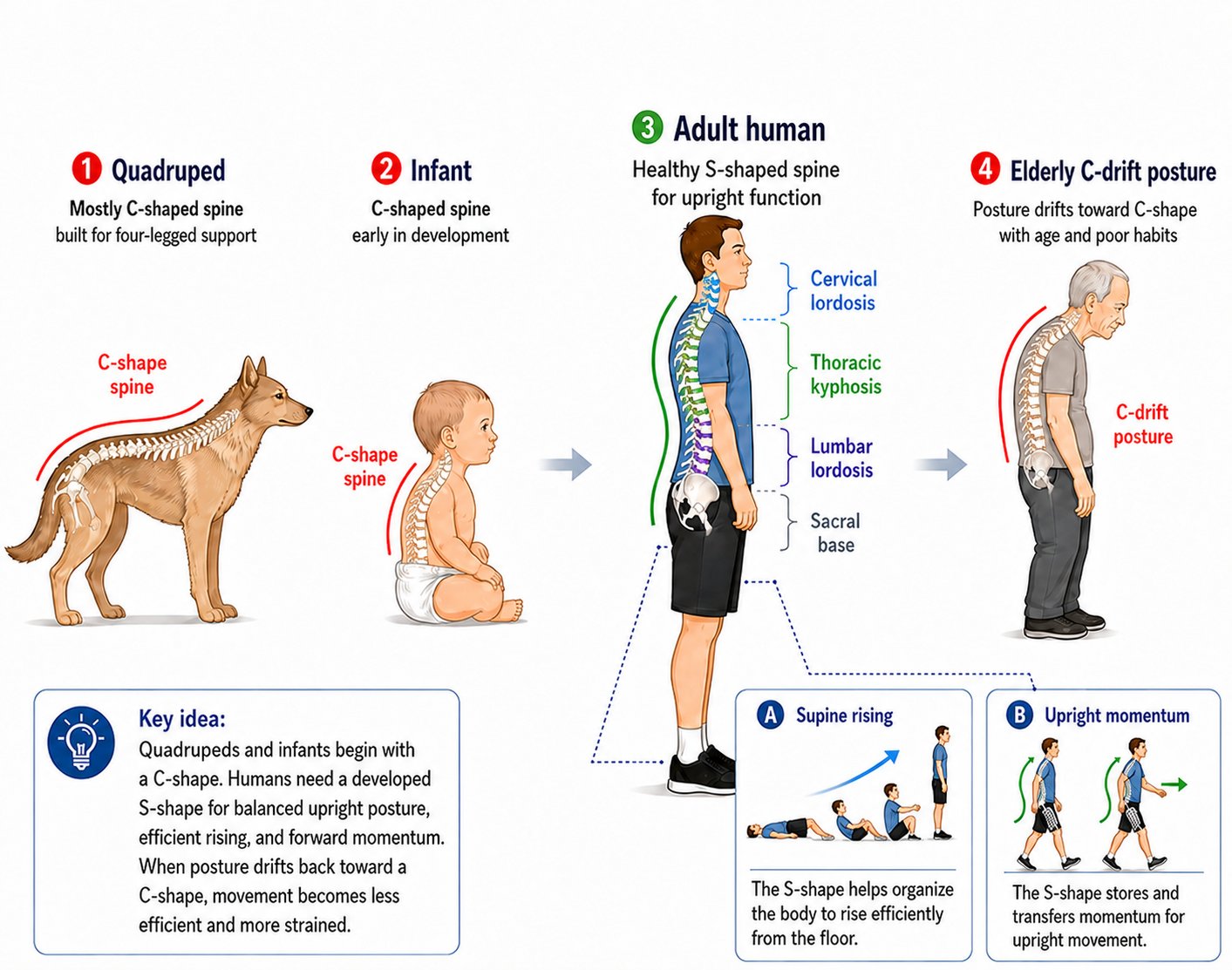
My book Spinal Fitness describes the human spine over a lifetime as an arc in 3 stages: C-shape, S-shape, then a drift back toward the C-shape. Life begins in flexion, develops the upright S-shaped structure across approximately the first 18 years, which Dr. John Scherger’s research put at about 25% of the human lifespan, and often drifts back toward a flexed posture with age, accumulated strain, injury and loss of curve integrity. The book’s position is that the drift is common and should not be accepted as inevitable, and Chapter 19 asks whether the aging posture is decline or adaptation. The purpose of Spinal Fitness is to interrupt the drift by preserving and restoring the curves that make upright function possible.
Why the aging posture can be an adaptation
Chapter 19 accepts that degeneration, disc narrowing, muscle weakness and structural failure are part of the description of an aging spine. It adds a mechanical reading. The S-shaped spine is superior, and it is also more demanding to maintain: its curves create shear forces at every level that the discs, facets, ligaments and muscles must control. When those stabilizing structures in the spine become damaged, inflamed, degenerated or fatigued over decades, the body may move toward a simpler structural arrangement.
A rounded, more C-shaped posture reduces some of the shear demand during quiet upright standing and lets the person stay upright with less reliance on tissues that can no longer stabilize reliably. In that sense the aging posture can be the body’s attempt to keep standing with the resources it has left. The cost is the set of abilities the S-shaped spine provides: trunk power, stride length, rotation, speed, effective momentum and the capacity to generate force in several directions. The book’s summary sentence: the aging spine becomes safer for stillness but weaker for life.
What the drift costs in daily movement
Chapter 5 lists the movements that show the loss. As people lose spinal curves, they shorten their stride, bend forward, brace through the hips and hamstrings, and avoid tasks that require forward drive. Getting out of a chair, climbing stairs, catching balance, pushing open a heavy door, carrying groceries, walking uphill and recovering from a stumble all require force transfer through the spine. When the spine drifts toward a C-shape, both effective mobility, the ability to move upright on 2 legs, and effective momentum, the ability to move the trunk into resistance, decline together.
The force data show why. With the center of upper-body trunk mass only 4 inches too far forward of the hips, hip shear rises from about 50 to 146 pounds and compression from about 87 to 924 pounds, with the hamstring working at about 843 pounds. Each inch of forward head position adds about 10 pounds of effective load to the cervical spine, and in forward head posture the posterior neck muscles work approximately 4 times harder to hold the head upright.
Constructive and needless effects
The book’s answer is management: the S-shaped spine must be developed, restored when lost, and managed for life. Management of the spine means knowing both what to apply and what to avoid. Constructive effects are the inputs that move the body toward the S-shape: decompression, curve restoration, segmental alignment and controlled progressive loading in mechanically sound positions. In the book’s 5 steps those inputs are Back Trac rolling, the Pelvic Tilt over a fulcrum, the Sit-Up over the PowerCushion, Neck Flexion at the beginner dose of 6 reps, 6 sessions a day, with strain and no pain, and the Spinal Twist with supported rest capped at 18 to 20 minutes. Needless effects pull the body toward the C-shape: prolonged unsupported sitting, repeated forward-bent work without recovery, excessive posterior loading, poor return from injury, and training that reinforces compensation. For the older adult, the book defines the goal as preserving enough spinal structure to keep walking, standing, breathing, reaching and living with independence.
The book’s 5 stages of disc degeneration end at stage 5, fusion of the segment, where the goal shifts to protecting what remains. Where segments of the spine are naturally or surgically fused, those segments cannot be reshaped, and the program focuses on optimizing what can change, improving force management and protecting the adjacent segments. The book separates 2 outcomes: pain relief alone may let a person tolerate decline more comfortably, and structural restoration, even partial, gives the person a chance to recover function.
What I do at my own age
The book’s About the Author records that at an age when many people expect decline, I feel stronger, healthier and more vibrant than I did in my 20s. From January to July 2026 I lifted 2 times a week and walked 3 days a week, and my Hume readings showed about 11 pounds of muscle gained and 12 pounds of fat lost, a net scale change of about 1 pound. The strengthening that holds the curves is curvature-inducing work for the postural muscles. My bone density has always been normal, and for bone I recommend hair analysis, supplements and jumping.
Chapter 19 states Dr. John Scherger’s teaching motto: “Feeling is the last part of learning and the first part of knowing.” Understanding the mechanics and following the program come first, and the change becomes conviction when a person feels it: better posture under fatigue, more strength from less effort, less stiffness, greater balance and an improved stride. Throughout the program, pain, numbness, tingling and dizziness are signs to stop, get evaluated, and then proceed with a therapeutic exercise program designed by a Spinal Fitness expert.
Keep Exploring
This article is for educational purposes only.