

A person can be active for decades yet gradually lose the freedom to turn their head while driving, reach a high shelf, get down to the floor, or walk comfortably after sitting. That is why learning how to age with mobility is not simply about exercising more. It is about reducing the stresses that make movement feel smaller year after year – before stiffness becomes your normal.
Mobility is one of the clearest expressions of independence. It affects how confidently you travel, play with grandchildren, work in the garden, carry groceries, and recover from an ordinary busy day. The goal is not to move like you did at 25. The goal is to build a body that continues to adapt, support natural alignment, and serve your life well.
How to Age With Mobility Starts With Your Foundation
Many people chase flexibility when the real issue is a foundation problem. If the head has drifted forward, the upper back is rounded, the ribs are not moving well, or the pelvis is held in a constantly tilted position, the body has to compensate. Muscles work overtime to keep you upright. Joints may lose options for movement because the nervous system is trying to create stability.
This is why stretching alone can feel good for an hour but fail to create lasting change. A tight muscle is not always a short muscle. Sometimes it is a hardworking muscle protecting an area that lacks alignment, strength, circulation, or control.
The Eileen Durfee Method looks at the connected systems behind functional movement: posture, spinal fitness, recovery, breathing, nutrition, mineral status, environmental stress, and daily habits. When you address the source of stress on the body rather than chasing one sore spot, you have a better chance to restore better function over time.
Posture Is Movement Preparation
Posture is not about forcing your shoulders back or standing rigidly. Functional posture gives your joints a better starting position for movement. When the spine can stack and move with more balance, the shoulders, hips, and knees do not have to compensate as aggressively.
Start noticing the positions you repeat. Looking down at a phone, leaning into a laptop, reclining with your neck unsupported, and sitting for long periods can all reinforce patterns that make upright movement more difficult. Awareness is not a cure, but it is the beginning of change.
A useful practice is to break up long sitting periods with a brief reset: stand, breathe slowly into the rib cage, let the shoulders relax away from the ears, and take a few easy steps. These small interruptions give the body more movement variety than one intense workout after a day of stillness.
Build Strength That Carries Into Daily Life
Mobility without strength can leave you feeling loose but unstable. Strength without mobility can make movement feel restricted. Healthy aging requires both, along with the coordination to use them when life is not perfectly controlled.
Focus on foundational patterns: getting up from a chair, hinging at the hips, stepping up, carrying manageable weight, pulling, pushing, and rotating with control. These are not glamorous movements, but they prepare you for real life. They also reveal where you may need to slow down and rebuild your mechanics.
The right starting point depends on your current capacity. Someone with knee discomfort may begin with a higher chair and a smaller range of motion. Someone who has been sedentary may need short, frequent sessions rather than a demanding program that leads to excessive soreness. Progress comes from consistency, not punishment.
Spinal fitness deserves special attention because the spine is the central support system for nearly every daily movement. Gentle, purposeful tools that encourage extension, decompression, and postural awareness can complement strength training when used appropriately. The goal is not to force the spine into a position. It is to give the body a chance to experience better alignment and gradually build the strength to maintain it.
Patented spinal fitness tools such as the Neck Shaper Kit and Back Trac, available through Creatrix Solutions, were developed for real-world posture challenges. They can be useful additions to a broader routine, particularly for people who need a practical at-home way to work on postural habits. As with any new exercise or device, begin conservatively and seek qualified guidance if you have an injury, recent surgery, persistent symptoms, or questions about safety.
Treat Recovery as Part of the Mobility Plan
A body that never recovers does not move its best. Sleep, stress load, hydration, adequate protein, and regular low-intensity movement all influence how ready your tissues and nervous system feel for activity.
Recovery is often where motivated people get stuck. They add more classes, harder workouts, and more stretching, while overlooking the fact that their body is running on poor sleep and a high stress level. A better question is: what helps my body recover enough to train again with good form?
Near-infrared heat can be one supportive recovery practice for some people. A well-designed sauna session may help you relax, warm up stiff tissues, and create a calming transition after a demanding day. It is not a replacement for movement, sleep, medical care, or hydration. It is a tool that may fit well when combined with sound daily habits.
Sauna Fix near-infrared sauna systems were created with practical home wellness in mind. For adults who tolerate heat well, a sensible routine can support relaxation and recovery. Heat is not right for everyone, however. People who are pregnant, have cardiovascular concerns, take medications that affect heat tolerance, or have other health conditions should ask a qualified clinician what is appropriate for them.
Support the Systems That Help You Adapt
Your muscles and connective tissues do not operate separately from the rest of you. Energy production, hydration, digestion, sleep quality, and the body’s natural detox pathways all influence resilience. If you feel depleted, cramp easily, struggle to recover, or cannot sustain healthy activity, it may be time to look beyond the workout itself.
Minerals are one area worth considering. They are involved in muscle contraction, nerve signaling, fluid balance, and many enzyme processes. Yet a random supplement plan is not always the best answer. Individual needs vary with diet, stress, medications, activity level, and overall health.
Hair Tissue Mineral Analysis, or HTMA, can offer one educational perspective on long-term mineral patterns. It should not be treated as a diagnosis, but it may help guide a more personalized conversation about food, supplements, and lifestyle support. Wellness Shopping Online offers HTMA resources and nutritional support for people who want to take a more individualized approach.
Your environment matters, too. Poor indoor air, harsh chemical exposures, and inadequate water quality can add to the total load your body has to manage. The practical aim is not perfection or fear. Improve what you can: ventilate your home, choose simpler products where feasible, prioritize clean water, and create a sleep space that supports rest.
Keep Your Range of Motion Useful
Mobility is most valuable when it is connected to tasks you care about. Instead of only measuring whether you can touch your toes, ask whether you can turn to check traffic, squat to pick something up, reach behind you, climb stairs, and comfortably get out of bed.
Use daily movement as practice. Take a walk that includes gentle hills if that is appropriate for you. Sit down and stand up with control. Carry groceries evenly. Spend time on the floor if getting down and up can be done safely. These ordinary actions train confidence because they teach your body that movement belongs in everyday life.
At the same time, do not ignore pain that is severe, new, worsening, follows a fall, or comes with numbness, weakness, dizziness, chest discomfort, or other concerning symptoms. Mobility work should help you build capacity, not push through warning signs. A healthcare professional can help determine when an evaluation is needed.
Choose a Plan You Can Repeat
The most effective mobility routine is rarely the most complicated one. It is the one you can repeat on a normal Tuesday, while traveling, during a stressful season, and when motivation is low. Start with a manageable commitment: a daily posture reset, regular walking, two or three strength sessions each week, and a recovery habit that helps you sleep and feel ready to move.
Then observe what changes. Are stairs easier? Is your neck less tired at the end of the day? Can you stand taller without forcing it? Are you more willing to move because you trust your body a little more? Those are meaningful markers of progress.
Aging with strength and energy is built through choices that respect the whole body. Build a stronger foundation, use practical tools when they serve your needs, and give your body enough consistent input to remember what capable movement feels like.
What I Do Before Breakfast
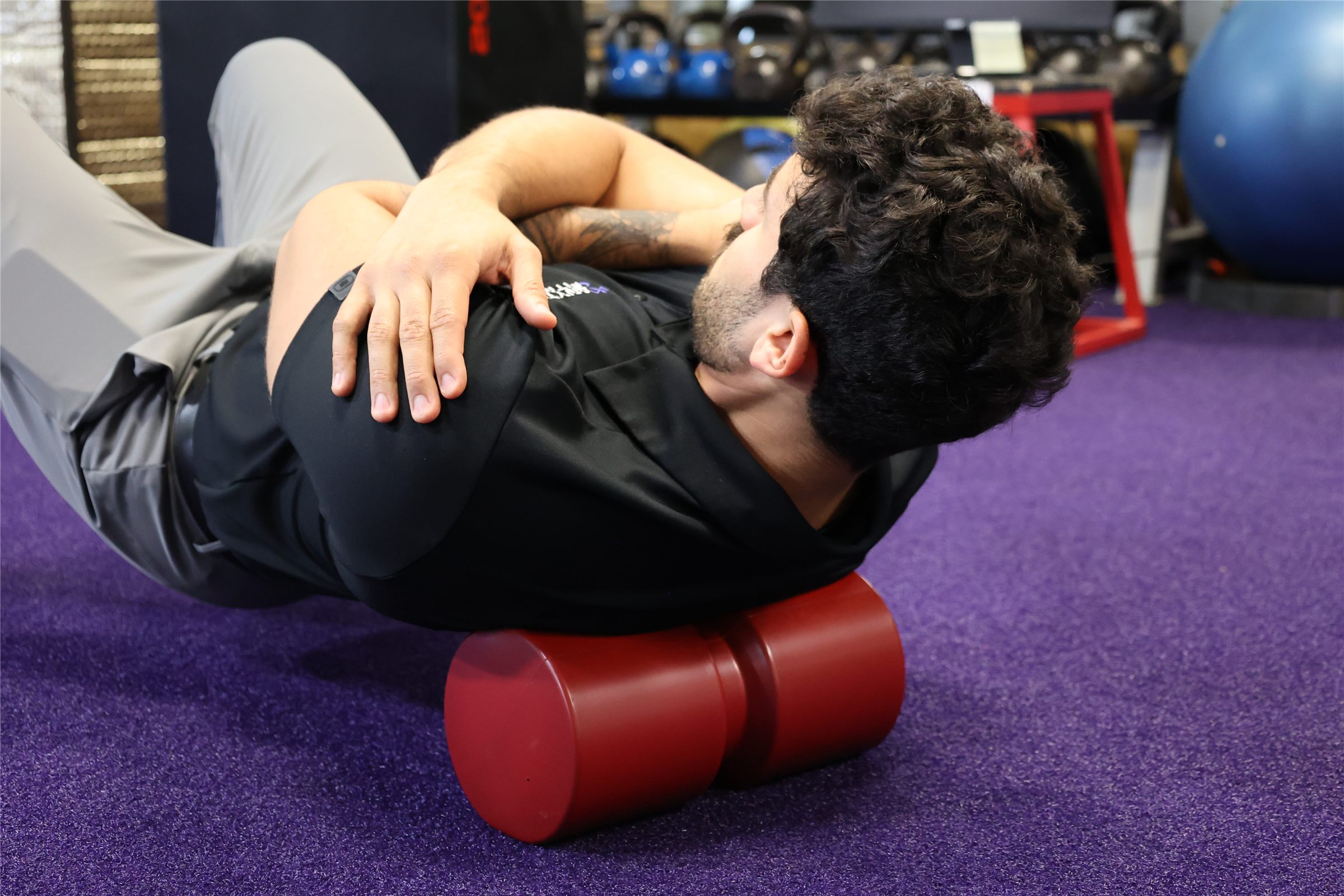
Since routines persuade better than theory, here is mine. Before breakfast, I spend three minutes over a foam roll restoring extension in my mid-back — the position sleep and gravity spend all night arguing against. Then one gentle minute for the neck curve on a smaller roll, because the head’s position governs everything below it. Most mornings that is followed by a near infrared sauna session; the radiant heat warms tissue from within, and I do my stretching inside the tent where the warmth makes every position easier. Water with a pinch of unrefined salt replaces what the session spends.
None of that is heroic, and that is precisely the point. I designed my routine — and the tools in it — around a rule I give everyone I work with: the practice has to survive your worst week, not decorate your best one. Ten minutes that happen daily will outperform the ninety-minute program that happens twice a month, every single time. Mobility at seventy is not built at seventy; it is built in the unremarkable mornings of the decades before.
That five-minute sequence is also the opening assignment I give nearly every client, because my own mornings proved it passes the only test that matters: it survives the worst week, not just the motivated one. In practice I see the same progression I lived — the first two weeks are remembering, the next two are noticing, and somewhere in the second month the body starts requesting the routine rather than tolerating it. When a client reports that skipping the rolls now feels wrong, the way skipping toothbrushing feels wrong, I know the mobility work has stopped being a program and become part of how they age — which was the entire point of the Eileen Durfee Method carrying it.
Frequently Asked Questions
At what age should mobility work start?
The best answer is “before you notice you need it” — the second best is today. Range of motion narrows so gradually that the driving-check and the high shelf are usually the first honest feedback most people get. Whenever you start, the body responds; the timeline is simply longer the longer the stiffness has been practiced.
Is stretching alone enough to stay mobile?
No — flexibility you cannot control is range the body will not let you use. Pair every new range with something that strengthens it: a slow sit-to-stand, a carry, a step-up. Mobility that shows up in daily function comes from the combination, never from stretching alone.
How is mobility different from flexibility?
Flexibility is how far a joint can passively go; mobility is how much of that range you can actively own — with control, under load, in real life. A dancer’s hamstrings are flexibility; getting off the floor without using your hands is mobility. Train for the second and the first tends to come along.
What if my joints ache after mobility work?
Mild muscle soreness that fades in a day is adaptation; joint pain that lingers or sharpens is information. Scale the range back to where movement feels smooth, build gradually, and let a qualified professional look at anything persistent — working with your body’s signals is faster than working against them.
How long before mobility work shows results?
Ease of movement often improves within a couple of weeks of daily practice; measurable changes — deeper squat, freer neck rotation — typically show over one to three months. The compounding is the reward: each year of consistent practice makes the next decade of movement cheaper.