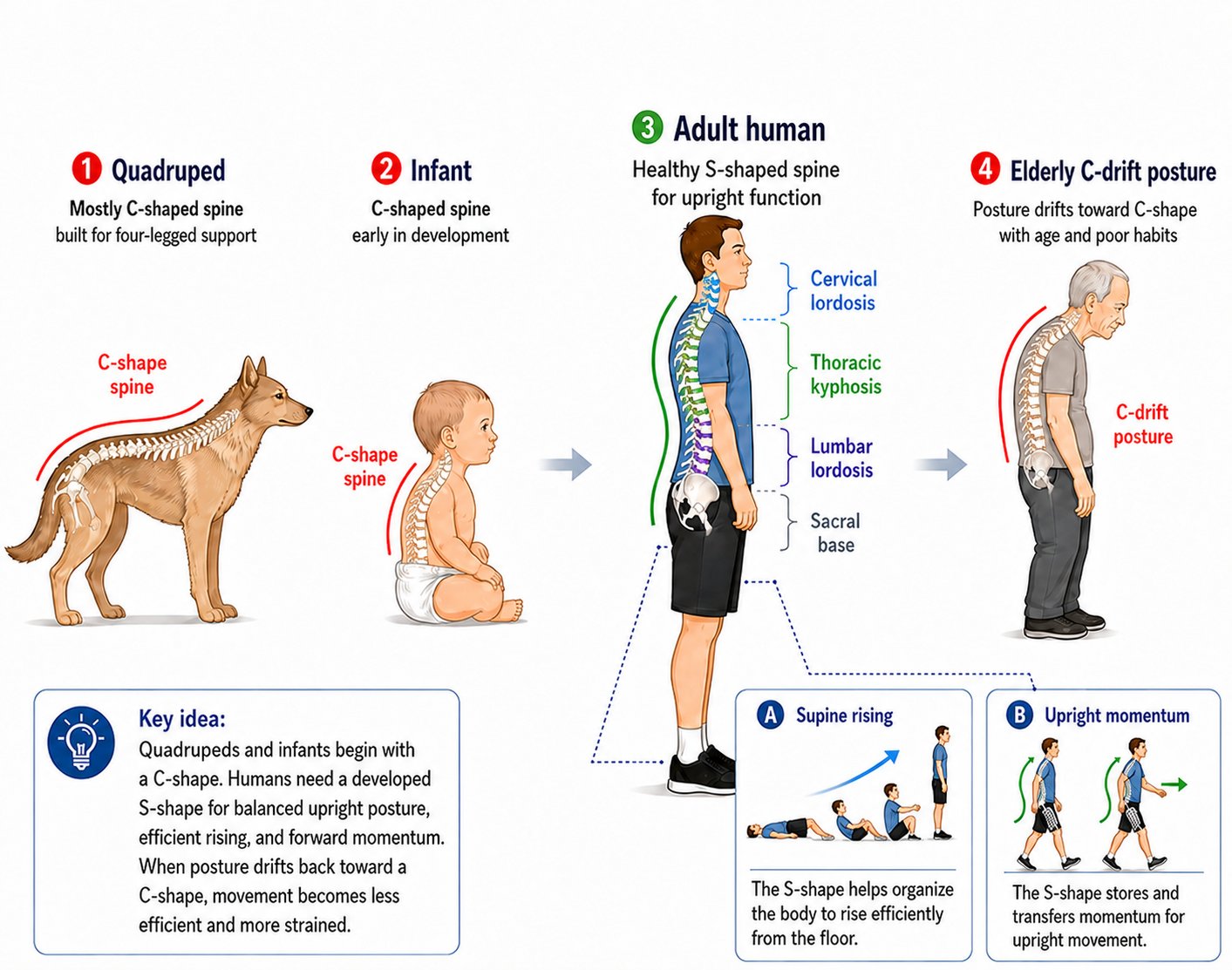

Chapter 18 of my book Spinal Fitness applies the method to space travel, where gravity, the force that builds the adult S-shaped spine, is removed. In microgravity, the spine adapts toward what the chapter calls a space-neutral posture: more flexed and more rounded, resembling the fetal or elderly bent-over spinal pattern instead of the Earth-normal S-shape. That posture may be functionally adequate in weightlessness; it becomes a mechanical disadvantage when the astronaut returns to gravity.
Why the spine changes without gravity
On Earth, the spine develops its S-shaped structure over approximately the first 18 years of life in response to gravitational loading, and the muscles that maintain upright spinal alignment work against that load every day. In microgravity, the constant downward force on the spine is gone. The postural muscles are used differently, the spinal joints no longer receive the same daily loading, and over time the body adapts away from the Earth-based S-shaped posture it no longer needs to function in weightlessness.
The chapter’s principle is that space-normal posture is not Earth-normal posture. An astronaut who enters space with a strong Earth-ready spine can return with a space-adapted spine and face a significant mechanical disadvantage at re-entry, landing, standing, walking and emergency evacuation. The mission ends on the ground, in gravity, and the spine has to function there immediately.
The neck under returning gravity
The chapter singles out the cervical spine. In proper Earth-normal posture, the neck keeps its lordotic curve and the posterior neck muscles manage the load of the head efficiently. In a space-neutral or forward-head posture under gravity, those same muscles must work approximately 4 times harder to hold the head upright, disc forces increase, and balance and coordination may be compromised. In a rapid evacuation, the book classifies that loss of neck function as a safety issue, not a matter of comfort.
Chapter 15 gives the cervical compression load by posture under gravity. Proper lordosis carries 32 pounds of effective head load, a straight neck 64 pounds and forward head posture 117 pounds, and each inch of forward head position adds about 10 pounds of effective load to the cervical spine.
Recreating gravity for the spine
On Earth, Spinal Fitness uses gravity and resistance to induce and maintain the S-shaped posture. In space, the training has to recreate the mechanical effects that gravity normally provides, which the chapter describes as an artificial gravitational training field for the spine. The book lists 5 possible means for the exercises: specialized apparatus, resistance systems, straps, body positioning, or the astronaut’s own body weight in modified orientations. The principle is that if the body adapts to its environment, the exercise environment must be designed to keep the adaptations needed for Earth.
3 pillars of space spinal conditioning
Astronaut conditioning already addresses muscle atrophy and bone density loss as 2 major concerns in microgravity. The book adds posture as the 3rd pillar, because if the spine loses its S-shape, even preserved muscle strength may not be directed efficiently when gravity returns. Pillar 1 is muscle conditioning, keeping the spinal support muscles ready to resume their postural and movement work on return. Pillar 2 is bone loading, stressing bones and joints in constructive directions to preserve density and joint integrity. Pillar 3 is spinal posture preservation, actively training the cervical and lumbar curves so the body keeps the S-shaped structure.
Before, during and after flight
The chapter divides the program into 3 phases. Before launch, the astronaut builds and confirms the best possible Earth-normal baseline: S-shaped posture, neck curve, lumbar curve and spinal stabilizer strength. During flight, the exercise program repeatedly applies the forces that give the body a reason to keep the S-shaped structure, including decompression, curve-maintaining positions and resistance training in correct spinal orientations, starting before the body has fully adapted. After return, the spine, muscles, balance system and postural reflexes go through structured reconditioning, because re-entry into gravity is a major physiological transition and gravity is present immediately.
The lesson for a body on Earth
The chapter closes on the lesson that applies to every reader: the body becomes what its environment repeatedly asks it to become, and posture is adaptation. The astronaut’s spinal change is fast because gravity is removed entirely. The desk worker’s change is slower and mechanically similar: prolonged sitting, screen posture, passive support, poor training and repeated forward-flexed work pull the spine away from the S-shape. By the time a young adult enters the workforce at 18 to 25 years of age, the book notes, they may have spent 12 to 18 years of schooling sitting 6 to 8 hours per day. On Earth, the book’s broad proper-versus-improper model compares the same task in 2 structures: 77 pounds of total effort and 1,218 pounds of compression in proper structure, against 1,166 pounds of effort and 2,708 pounds of compression in improper structure, a 15-to-1 effort advantage.
In both of the book’s cases, the orbit and the desk, the answer is the same: train the spine deliberately back toward the structure its environment requires. On Earth that is the 5-step system: Back Trac rolling (Step 1), the Pelvic Tilt (Step 2), the Sit-Up over the PowerCushion (Step 3), Neck Flexion at 6 reps, 6 times per day (Step 4), and the Spinal Twist followed by supported rest on the Neck and Back Shaper rolls, capped at 18 to 20 minutes (Step 5). Pain, numbness, tingling and dizziness during any of it are signs to stop, get evaluated, and then proceed with a therapeutic exercise program designed by a Spinal Fitness expert.
Keep Exploring
This article is for educational purposes only.