
Look at yourself from the side in a mirror — or better, have someone photograph you at your desk mid-afternoon, when you have stopped performing good posture. If your ear sits forward of your shoulder, you are looking at the most common structural change of the screen era: the lost cervical curve. And unlike most posture talk, this is not about how you look. It is about a mechanical load your neck was never built to carry — and about a curve that can be deliberately, measurably restored.
Ten Extra Pounds Per Inch
Your head weighs ten to twelve pounds. Balanced atop a healthy cervical curve — the gentle backward C your neck is supposed to hold — the spine carries that weight almost effortlessly, stacking bone over bone the way an architect stacks a column. For every inch the head migrates forward of that stack, the effective load on the neck increases by roughly ten pounds. A head held three inches forward, which is a completely ordinary afternoon of laptop work, forces the neck and upper back to support forty-plus pounds. Hour after hour. Day after day. Year after year.
The body adapts the only way it can: muscles brace and stay braced, the natural curve flattens toward a straight line, and the discs begin absorbing pressure on their edges instead of their centers. Nothing about that adaptation is mysterious — it is exactly what an engineer would predict from the load diagram.
What the Lost Curve Costs
The early bill arrives as symptoms most people never connect to their neck: headaches blooming at the base of the skull by late afternoon, a ridge of upper-back muscle that massage relaxes for exactly one day, shoulders that creep toward the ears, and that distinct end-of-day feeling of carrying something heavy you cannot put down — because you are. Breathing shallows as the head-forward position compresses the space the upper ribs need to swing. Sleep suffers when no pillow arrangement feels right, since the structure itself has changed shape.
Left alone for enough years, edge-loaded discs and permanently braced tissue tend to progress the way any misloaded structure does — which is why the time to take a flattening curve seriously is while it is still a posture problem rather than a degeneration problem.
Why You Cannot Will a Curve Back
The universal prescription — sit up straight — fails for a mechanical reason worth understanding. Muscular effort can reposition the head for as long as the muscles hold out, which is measured in minutes. The curve itself is structural: it lives in the shape the vertebrae, discs, and supporting tissue have settled into. Willpower cannot remodel structure any more than gripping a bent fence post straightens it. Curves are restored, not willed — and restoration means applying a gentle corrective force in the opposite direction, repeatedly, over time, the same patient way the curve was lost.
What I Check First With Every Desk Worker
A perspective from my own practice, because this pattern built my career twice. The forward head found me first at an engineering desk — years of drawings and documentation in nuclear power, ten hours a day, with the base-of-skull headaches to show for it. When I retrained as a Nationally Certified Spinal Fitness Specialist and studied the biomechanical work of Dr. John S. Scherger, the mechanism behind my own symptoms finally had a name and, more importantly, a direction of correction. Restoring my own cervical curve was one of the experiences that convinced me structure responds to consistent, correctly aimed force — the principle the whole Eileen Durfee Method is built on.
So the first thing I do with any desk worker is take the same side-view photograph I once needed someone to take of me. We draw the line: ear against shoulder. Then I press gently where the bracing lives — the upper trapezius, the base of the skull — and watch their face confirm what the photo already said. Almost every client is surprised; the head migrated forward a millimeter at a time, and no mirror they face straight-on ever showed them. The photograph turns an invisible habit into a measurable starting point, and remeasuring that same photo every few weeks turns restoration into something you can watch happen.
Restoring the Curve: Give the Neck the Opposite Input
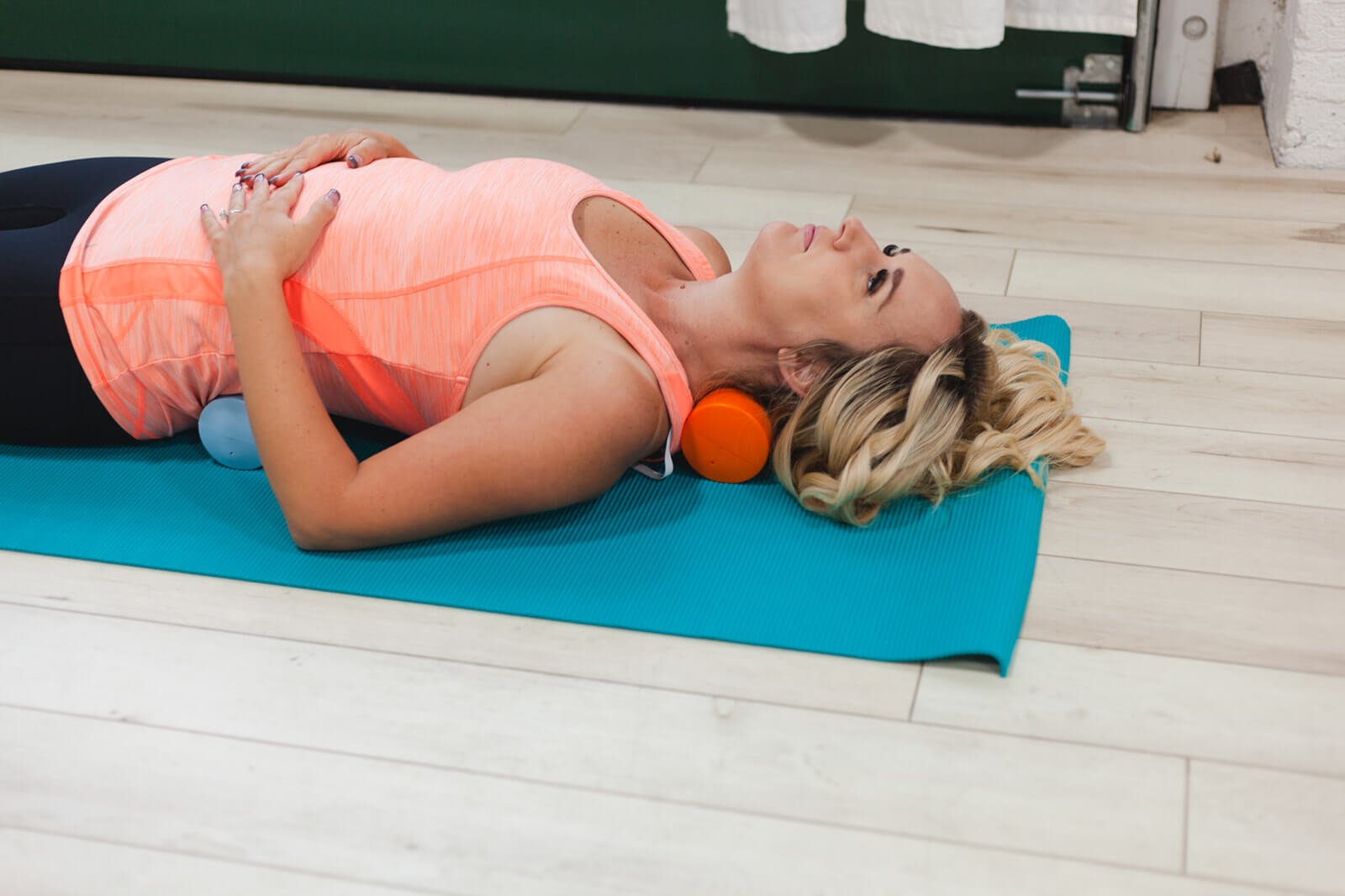
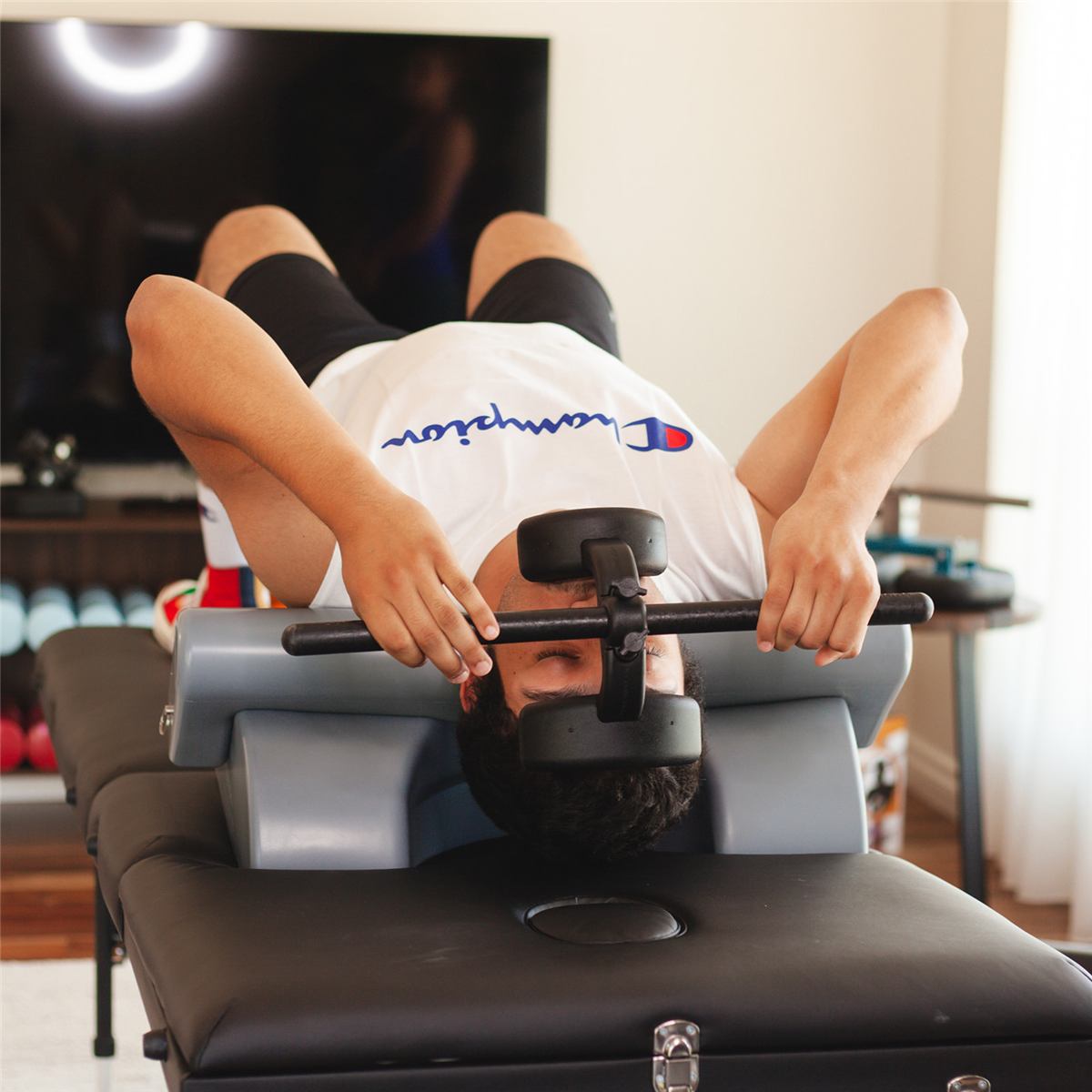
If the curve flattened under years of forward load, restoration means supplying the reverse: gentle, supported extension that encourages the neck back toward its designed shape. This is precisely the job I designed the Neck Shaper to do — a contoured support the neck rests over for a few quiet minutes a day, letting body weight and gravity apply the corrective force no amount of sitting up straight can. A few minutes of correctly aimed input, daily, outworks an hour of postural vigilance, because it addresses the structure rather than the symptom.
The daily sequence I teach pairs that structural input with movement: rest over the support, then follow with the gentle cervical work from the Spinal Fitness system so the newly encouraged position gets reinforced by muscles waking up rather than muscles bracing.
The Desk Changes That Actually Help
- Raise the screen. The top third of the monitor at eye level; a laptop gets a stand and an external keyboard. The head follows the eyes — aim the eyes correctly and the head stops chasing the screen downward.
- Bring the phone up. Eye level, elbows against ribs. The phone posture is the laptop posture with a worse angle.
- Break the position every 30 to 45 minutes. Stand, look at something across the room, roll the shoulders through their full range twice. The point is interrupting the brace before it sets.
- Check the car and the couch. Headrests and armrests hold the same forward position; the desk is rarely the only offender.
A Two-Week Reset
Fourteen days is enough to feel the direction of change, if not the destination. Take the side-view photo on day one. Do the few minutes of supported extension daily, add the screen and break changes above, and take the photo again on day fourteen under the same conditions. Most people notice the end-of-day heaviness easing within the first week — the braced muscles get relief before the structure visibly moves. The photo pair tells the truth either way, and a monthly photo from then on becomes your progress chart.
Frequently Asked Questions
I have had a forward head for twenty years. Is it too late?
Structure that changed slowly tends to change back slowly — but it tends to change. Age and years of adaptation affect the timeline more than the possibility. The people who should moderate expectations are those with diagnosed disc or vertebral conditions, who belong in a practitioner’s care before starting any self-directed correction.
Does the pillow matter?
Considerably. A too-thick pillow holds the head forward all night, quietly undoing the day’s work. The goal is a neutral neck in your usual sleeping position — side sleepers need more fill than back sleepers, and back sleepers with a flattened curve often do best with modest support under the neck itself rather than a tall pillow under the head.
Are my headaches really coming from my neck?
Base-of-skull headaches that build across the workday and ease with movement carry a strong postural signature, and many people find them improving as the load comes off. Headaches with other patterns — sudden, severe, or unlike your usual — deserve medical evaluation rather than a posture experiment.
Should I see a chiropractor instead of doing this myself?
The two are not competitors. Hands-on care can free restricted segments; daily structural input and desk changes are what keep the correction from eroding between visits. What I built for clients is the daily half — the half only you can do, because you are the one at the desk.
How fast will the photo change?
Symptom relief usually leads, structural change follows. Expect the felt difference in one to three weeks and visible photo change over months, in proportion to how many years the curve took to flatten. Slow is normal. Slow and measurable is winning.
The full library of spinal mechanics guides lives on the Spinal Health & Biomechanics pillar, and if you want to know whether your posture is aging you faster than your birthdays are, the free posture self-assessment takes ten minutes with a mirror and delivers an honest answer.
Keep Exploring
This article is for educational purposes only and does not constitute medical advice. Consult a qualified professional before beginning any new exercise program.