
In Dr. John Scherger’s upright contact comparison, published in my book Spinal Fitness, improper posture standing still against a force from the front needs 282 pounds of muscular effort and produces 36 pounds of shear, while proper posture in the same static position needs 776 pounds of effort and produces 1,584 pounds of shear. Read alone, those numbers favor poor posture. The book prints them to show why a spine has to be judged in motion: in the range-of-motion comparison, where each posture moves into its best position against anterior resistance, proper posture needs 77 pounds of effort against 282 for improper posture.
The static numbers, in full
In the upright static comparison, proper neutral spinal posture shows 776 pounds of effort, 1,584 pounds of shear and 4,687 pounds of compression. Improper posture shows 282 pounds of effort, 36 pounds of shear and 2,166 pounds of compression. The book calls the conclusion that improper posture is better a mistake, because pushing, bracing, contact and real force production are about moving the resistance, not standing upright and holding still against it.
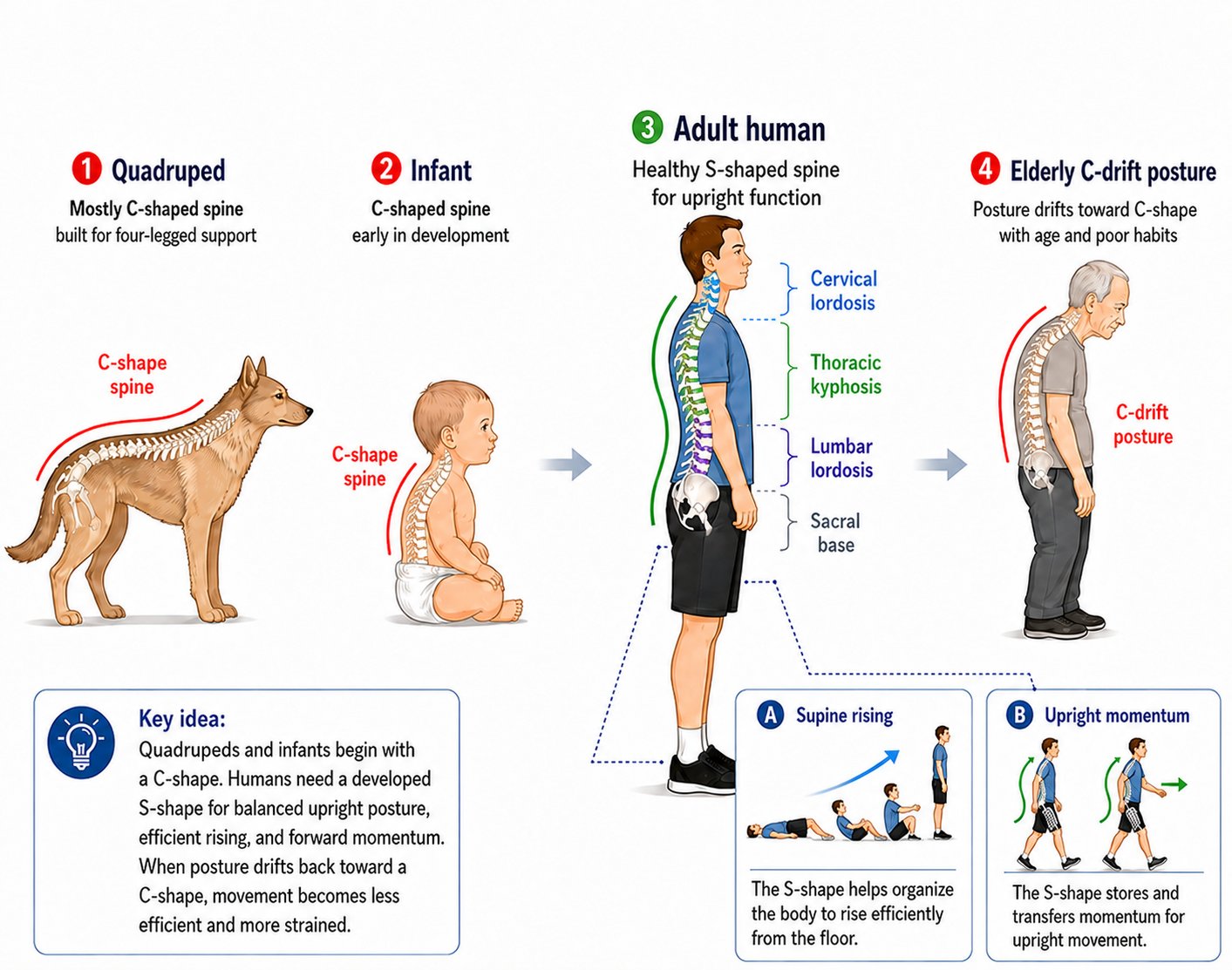
The rule the chapter draws from it: improper posture protects itself by avoiding motion, and proper posture gains advantage through motion. A person with improper spinal structure keeps the only stability they can access by staying upright, and leaning into the load moves them toward instability. A person with proper spinal curves can hinge forward and drive through the structure, with the pelvis, spine, legs and ground working as 1 force-transfer system.
The range-of-motion comparison
The book calls this the most important contact comparison: each posture moves through its best available range of motion against anterior resistance. Improper posture’s best position requires 282 pounds of total effort and creates 2,166 pounds of compression. Proper posture’s best position requires 77 pounds of effort and creates 1,218 pounds of compression. That is a 3.5-to-1 advantage in effort and about a 1.8-to-1 advantage in compression for the curved spine.
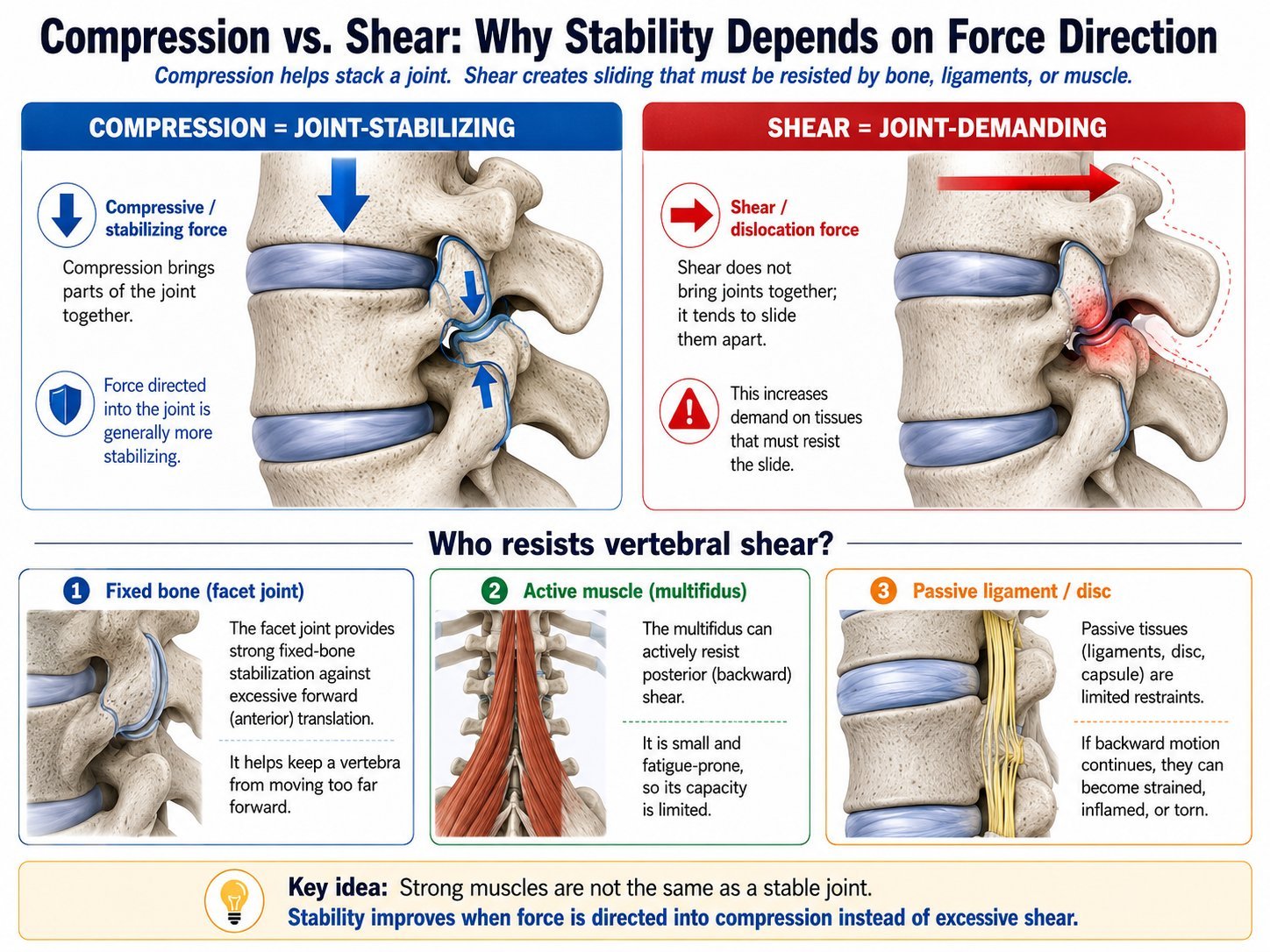
Dr. Scherger named this ability effective momentum: moving forward against a resistance force while the spinal joints become more stable through compression-dominant loading. As the lordotic curves move toward anterior resistance, body weight and muscular effort are directed into the joints as compression, so stability and power increase together. A C-shaped spine moving into the same force sends more of the resultant across the joints as shear, so stability decreases as effort increases.
The football model: more parts, more places to fail
The contact model counts the anatomy each posture needs. Poor posture uses approximately 349 pounds of total effort with a total resultant force of about 479 pounds, and it recruits 4 muscles and 3 joints, commonly represented as L3-L4, L4-L5 and L5-S1, with multifidus bundles running from L2, L3, L4 and L5 to the sacrum. Good posture uses about 191 pounds of effort with a resultant of about 223 pounds, and it needs 2 muscles and 1 joint taking compression, shown at L2-L3, with minimal anterior stabilizing indicators, including the rectus abdominis and psoas major.
The book states the force path for each of the 2 postures. Good posture: ground, legs, pelvis, spine, point of contact. Poor posture: ground, legs, collapsed spine, shear, muscle stabilization, reduced contact force. More parts means more places to fatigue, more places to fail, and more tissue exposed to compression and shear.
3 costs of poor momentum
The chapter lists 3 performance costs. The effort cost: more muscular effort to produce less usable force, which is why a worker or athlete can feel they work harder than everyone else for the same task, because the body spends energy stabilizing posture and shear before force reaches the task. The force cost: more compression and shear accumulate inside the joints. The anatomy cost: more muscles activate and more joints absorb force to stabilize the same movement, as in the 4-muscle, 3-joint football model against the 2-muscle, 1-joint model.
The 6 questions I wrote for trainers
The trainer application in Chapter 5 turns the comparison into 6 observation questions for any movement into force. 1: Does the person hinge from the hips or collapse through the spine? 2: Does the spine remain a structural column, or does it become the bending point? 3: Does force travel through the pelvis and legs, or does it leak into the low back? 4: Does the person brace before moving? 5: Do the hamstrings, neck or low back muscles work to hold the trunk in place? 6: Does the person gain stability as they move into force, or lose it?
The clinical instruction that goes with those 6 questions: when a person cannot lean forward into resistance without collapsing, rounding, bracing or pain, the issue is not only strength; it may be a loss of effective momentum, with the body protecting itself from a force position it cannot stabilize. Training should not force more load onto poor structure. It should restore the spinal curves, improve pelvic control, rebuild segmental stability, and then progressively teach the body to transfer force again. Pain, numbness, tingling and dizziness at any stage are signs to stop, get evaluated, and then proceed with a therapeutic exercise program designed by a Spinal Fitness expert.
What this means for a standing posture check
In the side-view stacking screen, the ear, shoulder and greater trochanter are checked for a vertical line: Green is the head stacked close to the shoulders, the thorax not drifting forward and the pelvis centered; Red is obvious turtle posture, shoulders rolled forward and down, and trunk mass visibly ahead of the hips. The book’s functional confirmation uses the split-stance lunge, single-leg hinge, standing reach and gait to confirm the dominant compensation strategy, and gait, the split-stance lunge and the overhead reach are retested after every corrective session. Chapter 5 lists getting out of a chair, climbing stairs, catching balance, pushing open a heavy door, carrying groceries, walking uphill and recovering from a stumble as tasks that require force transfer.
Keep Exploring
This article is for educational purposes only.