
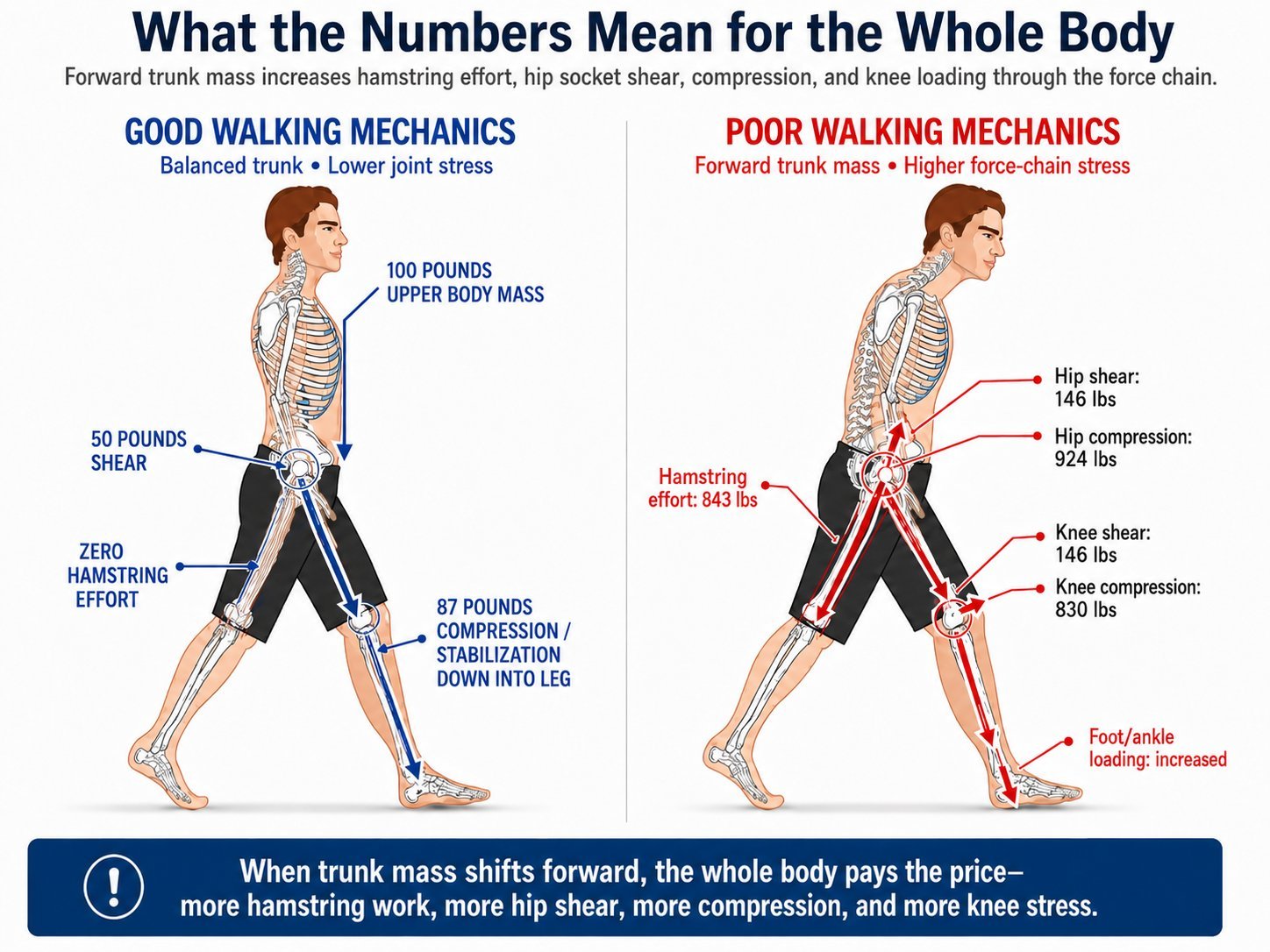
In Dr. John Scherger’s force data, published in my book Spinal Fitness, a hamstring works at about 843 pounds when the center of upper-body trunk mass sits only 4 inches too far forward of the hips. With an ideal S-shaped spine, the same hamstring muscles are relaxed. The book’s reading of chronic hamstring tightness follows from that 843-pound load: the muscles are often overloaded by a forward trunk, not short.
The hip and knee numbers
With an ideal S-shaped spine and relaxed hamstrings, hip socket shear is about 50 pounds and compression about 87 pounds, extending into the knee. When the center of upper-body trunk mass moves 4 inches too far forward, shear rises to about 146 pounds and compression to about 924 pounds, with the tightened hamstring working at about 843 pounds. Those figures come from Dr. Scherger’s mathematical analysis of the hip and knee joints, and the book applies them to every step a person takes in that posture.
In Dr. Scherger’s walking and running analysis, with good posture and the trunk stacked over the hip joint, the planted leg’s hamstring may require essentially zero effort for postural maintenance. With the upper trunk shifted forward, the same muscle generates substantial effort just to keep the body upright, and the book names 4 results: the runner loses stride, the worker loses endurance, the athlete loses explosiveness and the older adult loses confidence in balance.
Effective mobility and the hamstring’s second job
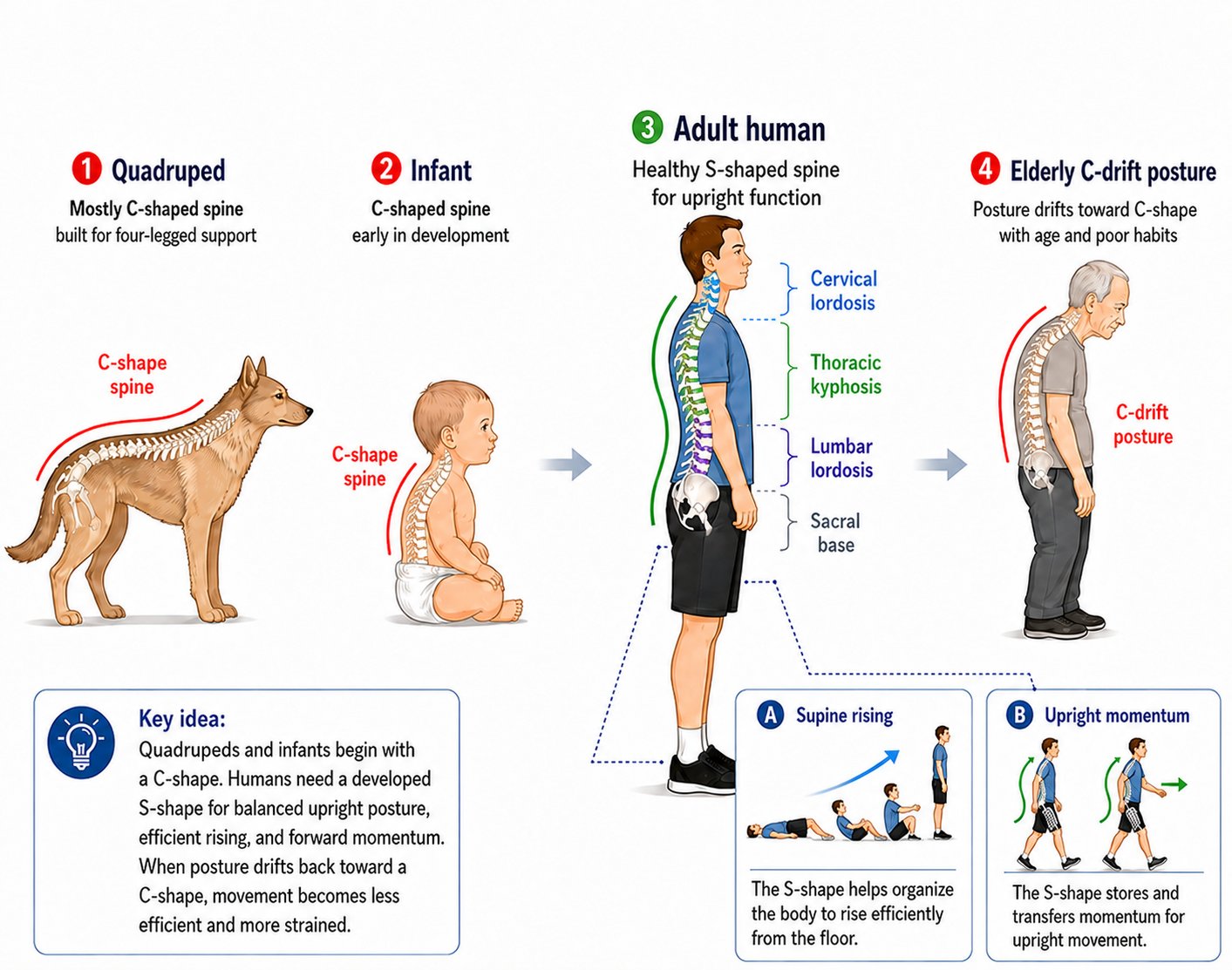
Dr. Scherger named 2 abilities the S-shaped spine makes possible: effective mobility and effective momentum. Effective mobility is the ability to stand upright and move through space on 2 legs, and it depends on balancing the upper trunk over the hip joints. With the trunk stacked, the stance-phase leg can stay straight, the stride can extend fully, and the hamstring muscles work on propulsion instead of postural support.
When the spinal curves are lost and the upper trunk shifts forward of the hips, the hamstrings take on a second job: holding the trunk from falling forward. In the book’s words, the hamstrings are not always short because they need stretching; they may be overloaded because the spine has lost the structure that should keep the trunk balanced. The spinal extensors work the same way, and the posterior neck muscles do the same work when the head drifts forward.
What the posture chain does to hamstring tension
Chapter 6 lists the length-tension changes of posture collapse muscle by muscle. With forward head posture, the cervical extensors and upper trapezius become tonic and short, and the deep neck flexors lose endurance and coordination. With rounded shoulders, the pectoral muscles shorten and the scapular retractors and lower trapezius lose their efficient length and timing. With a flattened lumbar curve, the hamstrings and the rest of the posterior chain become tonic and the trunk loses stable leverage. The global result is more co-contraction, less efficient movement and faster fatigue. Chapter 1 gives the cost at the head: each inch of forward head position adds approximately 10 pounds of effective load to the cervical spine.
A tucked pelvis changes hamstring tension and reduces the ability of the hip joints to extend fully (Chapter 3). The cost accumulates across the day: the body compensates well enough at the beginning of the day, and by the end of the day the person feels tighter, heavier, slower and less coordinated. The book’s instruction for that pattern is to restore the curves and teach the body to hold them under real doses of gravity, instead of only stretching what feels tight.
The same mechanism in the jump and the fiber type
In a vertical jump with the trunk forward of the hips, the quadriceps muscles drive the body up while the hamstrings work against them to keep the trunk from collapsing forward, and the jump travels forward instead of up. The book’s field test is to jump straight up and land: a balanced body lands in about the same spot it left. When the trunk sits forward of the hips and the hamstrings, spinal extensors and hip stabilizers hold the trunk upright continuously, that low-level endurance work signals the body to convert fast-twitch fibers to slow-twitch.
The S-shape develops across approximately the first 18 years of life (Chapter 2), and the book counts 12 to 18 years of schooling spent sitting 6 to 8 hours per day. Many workers arrive at a job with hamstrings that are chronically tight because the body has used them for years to keep the trunk from falling forward, along with overworked neck extensors, under-recruited deep postural stabilizers and flattened or reversed lumbar curves.
How the book corrects it
The appendix decision tree gives 2 rules for this pattern. First, a muscle that tests tight may be substituting for a weak synergist, so it is lengthened and the weak muscle activated in the same session. Second, Pattern 6, the bilateral posterior pelvic tilt, is defined by the hamstrings and a flexion strategy dominating, with thoracic flexion and a chin-forward head; its priority correction is to free the pelvis and restore true hip motion, and the pelvis is always corrected before the spine and the head.
The curve itself is built with active work from the anterior direction: the Pelvic Tilt over the PowerCushion for the L4-S1 segment, with about 70 pounds of resistance through the front of the pelvis in the book’s model, the Sit-Up over the PowerCushion starting at about 45 degrees, and Neck Flexion at 6 reps, 6 times per day. Passive time on a fulcrum, which builds from a few minutes toward 15 to 20 minutes, is preparation; adaptation of the spinal curves requires active function against the appropriate resistance. During any of these exercises, pain, numbness, tingling and dizziness are signs to stop, get evaluated, and then proceed with a therapeutic exercise program designed by a Spinal Fitness expert.
Keep Exploring
This article is for educational purposes only.