
The posture rule I wrote into the appendix of Spinal Fitness is: always assess and correct the pelvis before the spine, and the spine before the head. The order is not optional. The tool that applies it is a 60-second decision tree that maps the dominant compensation pattern in 7 steps, pelvis first and atlas last.
The 60-second decision tree, step by step
Step 1 asks whether the pelvis is tilted anterior or posterior: one anterior superior iliac spine (ASIS) more forward and down, both forward and down, or the whole pelvis tucked under. Step 2 compares iliac crest height to find which side is high, which points to a frontal-plane hike and a likely functional short leg. Step 3 checks rotation, meaning whether one half of the pelvis is rotated forward while the other is back.
Step 4 moves up to the ribcage and records flare or collapse, on one side or both, with any side-specific compression. Step 5 classifies the lumbar strategy as extended, flattened or side-bent. Step 6 reaches the top of the spine: whether the atlas, the first cervical vertebra, sits high left or right, whether the head is side-bent, and whether the chin is forward. Step 7 confirms the dominant strategy in movement with 4 tests: a split-stance lunge, a single-leg hinge, a standing reach and gait.
The 8 compensation patterns
The appendix groups the most common presentations into 8 patterns, and each pattern carries its key findings and a priority correction. Patterns 1 and 2 are a right or left anterior pelvic tilt bias. In Pattern 1 the right ASIS is forward and down, the right quadratus lumborum and erector muscles are tight, the left glute is under-recruited, the right ribs flare and the atlas often sits high on the right; the priority is to decompress the right side and anchor the left posterior chain. Pattern 2 is the same pattern with the left and right findings swapped.
Patterns 3 and 4 are a right or left pelvic hike. In Pattern 3 the right quadratus lumborum hikes the pelvis, the left gluteus medius underperforms, the thorax shifts left and the head often counterbalances; the priority is to drop the right side of the pelvis and restore the left lateral hip. Pattern 4 is the same pattern with the sides swapped.
Pattern 5 is a bilateral anterior tilt: lumbar erectors and hip flexors dominate, glutes and abdominals underwork, both sides of the ribcage flare, and forward head posture is common. Its priority correction is ribs down, pelvis back to neutral, and restored abdominal and glute function. Pattern 6 is a bilateral posterior tilt: the hamstrings and a flexion strategy dominate, with thoracic flexion and a chin-forward head position. Its priority correction is to free the pelvis and restore true hip motion.
Patterns 7 and 8 are a right or left pelvic rotation forward. In Pattern 7 the left posterior chain often overworks to stabilize, the trunk de-rotates and the head adapts to keep gaze level; the priority is to de-rotate the pelvis and reload the left posterior hip. Pattern 8 is the same pattern on the opposite side.
Where the head finding appears in each pattern
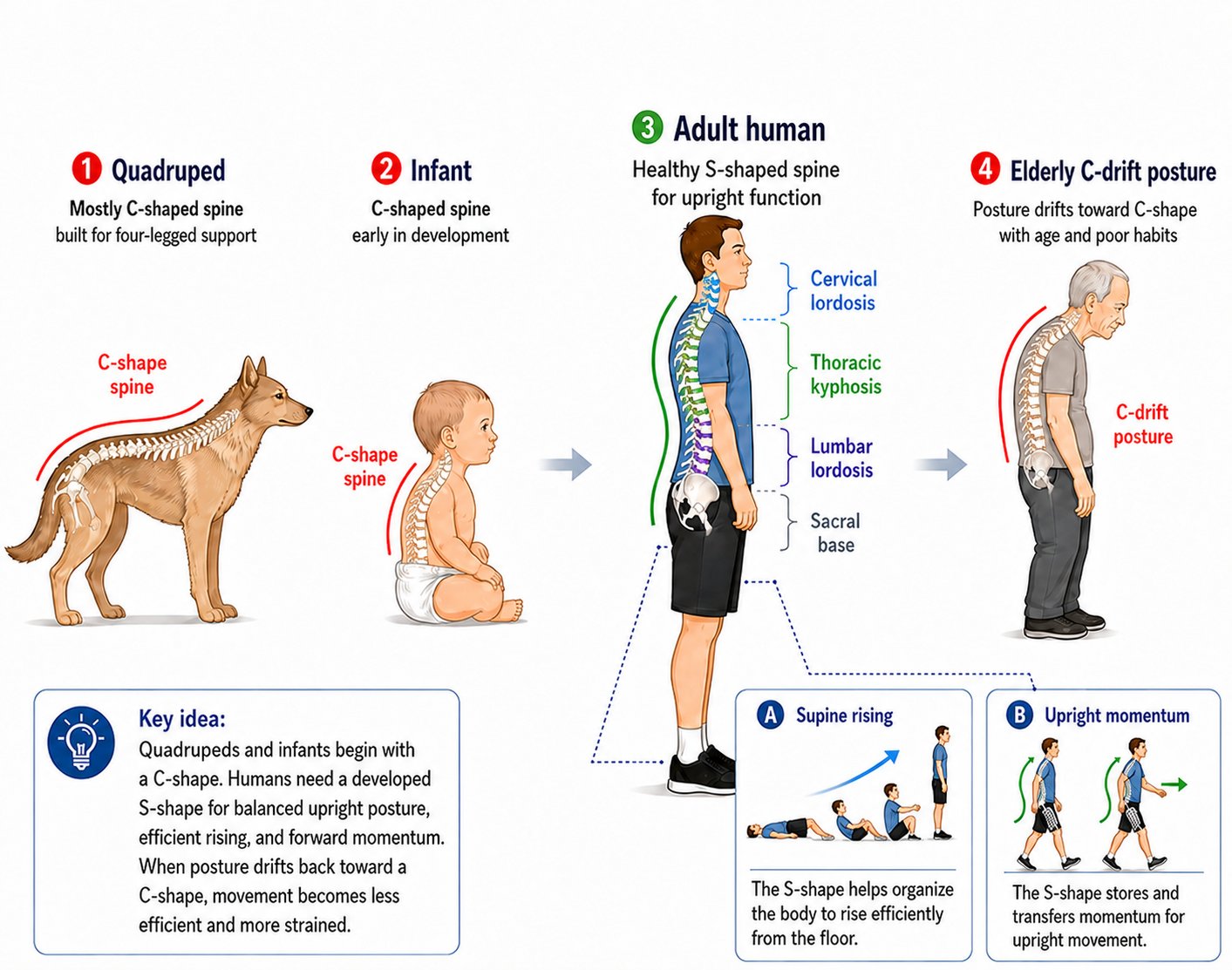
In all 8 patterns, the pattern is named for the pelvis and the head or atlas finding is listed with it: the atlas often high on the same side as the forward ASIS in Patterns 1 and 2, the head counterbalancing a hike in Patterns 3 and 4, forward head or chin-forward posture in Patterns 5 and 6, and the head adapting to gaze level in Patterns 7 and 8. Chapter 1 describes the same sequence in sitting: when the pelvis rolls back, the lumbar curve flattens, the thoracic spine rounds and the head drifts forward, and each inch of forward head position adds about 10 pounds of effective load to the cervical spine. The manual’s instruction is to identify the dominant compensation pattern, choose the primary corrective strategy, and reassess immediately after the sequence.
4 rules that apply to every pattern
The appendix closes with 4 universal posterior-chain rules. Rule 1 is the order stated at the top of this article. Rule 2: a muscle that tests tight may be substituting for a weak synergist, so the tight muscle is lengthened and the weak one activated in the same session. Rule 3: reassess immediately after the corrective sequence, and if the pattern has not shifted, re-examine whether the dominant pattern was identified correctly. Rule 4: retest gait, the split-stance lunge and the overhead reach after every corrective session.
Chapter 2 states that forward head posture, rib flare, constant hamstring gripping or quadratus lumborum (QL) dominance show increased cost per movement, and that this is the coaching moment to explain that better alignment is energy management.
Where the decision tree sits in the system
The decision tree is a movement-screening and corrective exercise framework, and when a finding is uncertain, the instruction is to refer to the appropriate medical provider before proceeding. In the full evaluation stack, the safety screen for red flags comes first, followed by the exposure profile, the posture and curvature screen, the tolerance check and track assignment. Pain, numbness, tingling and dizziness during any corrective exercise are signs to stop, get evaluated, and then proceed with a therapeutic exercise program designed by a Spinal Fitness expert.
The book names the Pelvic Tilt over the PowerCushion as the primary segmental exercise, targeting the L4-S1 relationship; the decision-tree manual itself names priority corrections, not specific exercises. In Dr. Scherger’s mathematical analysis of the pelvic tilt, approximately 70 pounds applied downward through the 2 ASIS points, with the lumbar vertebrae supported by the firm fulcrum, produces a resultant of about 201 pounds through the lower lumbar spine, with a calculated shear of 149 pounds at the S-L5 joint declining joint by joint to 7 pounds at L1-T12.
Keep Exploring
This article is for educational purposes only.