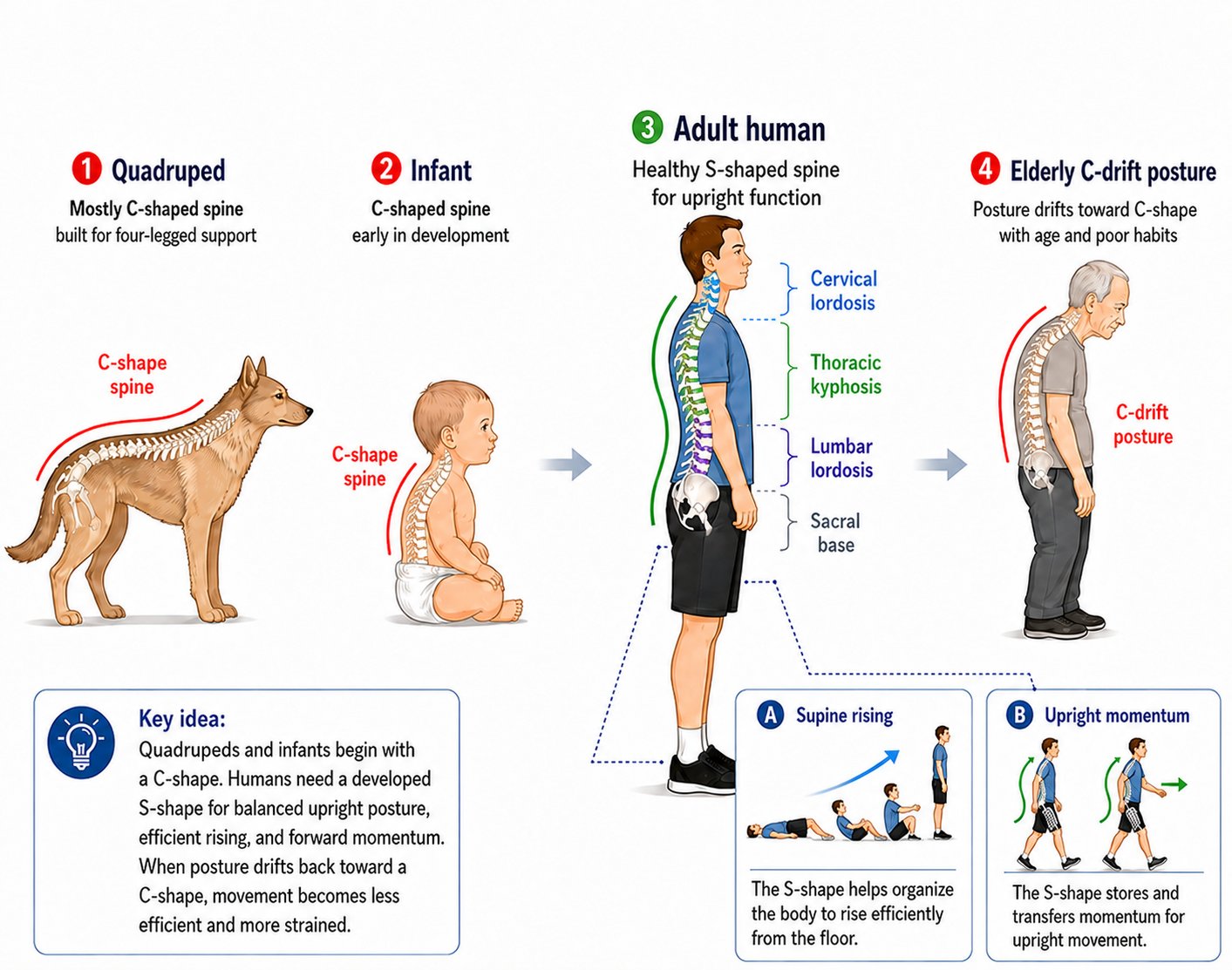

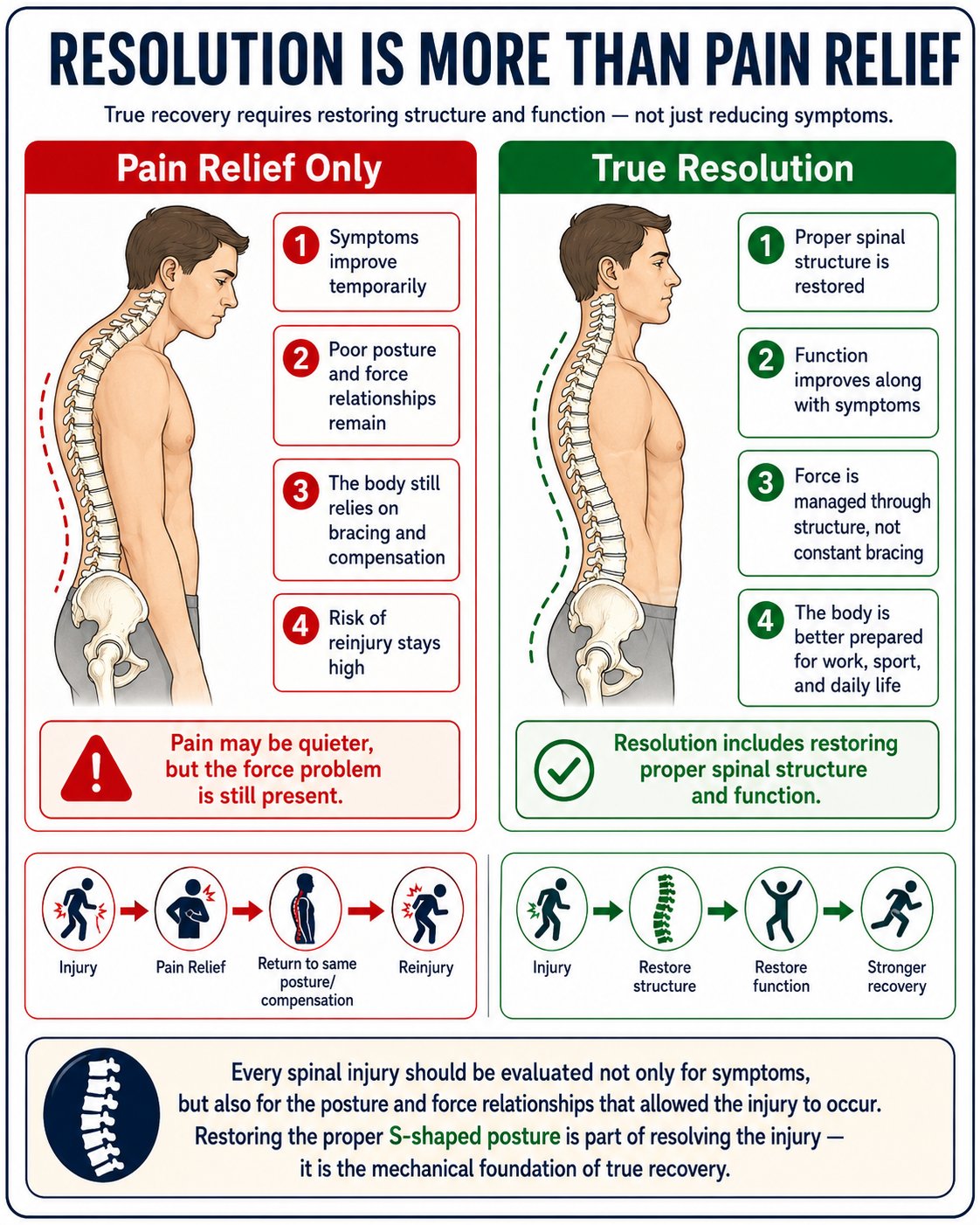
Chapter 2 of my book Spinal Fitness states that the most injured workers are often the most experienced ones: the people who have compensated the longest, with years of stronger and stronger substitution patterns behind them. For many workers, the book states, the first injury to the spine is the signal, not the real problem. In the book’s model, the spine has been working at a mechanical disadvantage for a long time before the incident report is written.
How a worker’s back breaks in stages
Chapter 1 describes the sequence in stages, and the book’s first line is that companies do not lose their best people all at once. The worker adapts and pushes through discomfort, taking the heavy tasks, filling staffing gaps, driving more and lifting more, and leadership often rewards that with more exposure. Then comes an incident that looks simple, such as a tweak, a muscle strain or an awkward lift. The worker “recovers” and returns to the job in protection mode, bracing the muscles, tightening and compensating just to keep the spine upright in gravity.
The best people tend to take what the book calls the in-between loads on the spine: the awkward carry, the lift that should have had help, the quick twist to save time, the extra drive at the end of a long day. Repeated micro-exposures of that kind shift posture, tighten tissues and change how the body distributes force, and from the outside the result is often misread as attitude, aging, weakness or poor work ethic.
The fatigue gap across a shift
Dr. John Scherger’s research showed a pattern in elite athletes that the book carries into warehouses, delivery routes and office work: 2 workers can start a shift doing the same job at different physical costs. The worker with proper spinal structure generates force through first-class lever systems and can lean forward into greater mechanical advantage under load, so the structure keeps distributing force through the joints and discs as fatigue builds. The worker without those spinal curves has to stay more upright to keep what stability they have, relies on muscular bracing, and spends more energy on that compensation every hour of the shift.
Chapter 3 gives Dr. Scherger’s broad proper/improper structure comparison: about 77 pounds of total effort and 1,218 pounds of compression for proper structure, against about 1,166 pounds of effort and 2,708 pounds of compression for improper structure, a 15-to-1 advantage in effort and about 2-to-1 in compression. On the football field, the same project that began in the mid-1980s found that players with a pronounced lumbar curve lasted longer, and that the curves flattened as a season accumulated trauma. By 2000 the sit-up, the pelvic tilt and the Power Cushion were in the New England Patriots’ medical training room, and by 2002 they were in the weight room.
Structural tolerance and cumulative load
The book defines structural tolerance as the spine’s capacity to manage mechanical demand without breaking down into pain, fatigue, guarding or injury. A worker with good spinal structure has a larger margin of safety because the S-shaped spine carries more of the load through the skeleton as compression, with less shear and less muscular bracing. A worker with flattened, reversed or collapsed curves has a longer resistance arm, harder-working muscles and stabilizing tissues that absorb more strain, and operates closer to failure even before any pain appears.
Cumulative mechanical load is the total force exposure the spine and supporting tissues absorb over time. The book’s example is 1 shift: a worker sits with poor posture for 6 hours, lifts several objects with the load too far forward, then pushes a cart with a rounded spine at the end of the day. Each of the 3 tasks looks ordinary, and each adds to the cumulative load. Under poor structure, ordinary work turns into repeated shear, bracing and tissue strain faster than the body recovers.
The reinjury loop in an experienced body
When spinal curves are incomplete, flattened or lost, the body substitutes muscle tension for structural stability. The muscles stay on and fatigue, fatigued stabilizers allow more shear at the joints, shear increases guarding, and guarding shortens tissues and changes movement: tightness, fatigue, strain, guarding, altered movement and reinjury. The nervous system adds 5 reflex-level compensations: more hip flexor grip, more lumbar extension, more shoulder elevation, more head-forward posture and more hamstring tension. The book’s clinical insight adds that when lumbar and cervical curves are incomplete, muscular bracing substitutes for structural stability, increases energy demand, accelerates fatigue and raises the probability of shear-dominant loading at vulnerable segments such as L4-L5 and L5-S1.
Chapter 2 states that under fatigue, the body does not choose the best posture; it chooses the most practiced posture, and if the most practiced posture collapses, that is where the body goes. The book applies this to the worker who arrives with a forward head, rounded upper back, tucked pelvis or flattened lumbar curve, a pattern rehearsed for years before the first day on the job; by 18 to 25 years of age, a young adult entering the workforce may have spent 12 to 18 years of schooling sitting 6 to 8 hours per day, and it describes the bodies of those workers as running on the wrong mechanical strategy: muscular bracing in place of spinal structure, under cumulative load.
The cost a company does not count
Chapter 2 lists 7 cost categories that rarely get tracked, even though they eventually show up on the profit and loss statement: productivity loss; overtime and backfill; training and retraining; quality errors and rework; absenteeism and presenteeism; morale damage and the retention cost that follows; and second-order injuries in the coworkers who compensate. It then names 3 costs that compound across a workforce: time, in micro-delays through a shift; energy, because constant muscle tension used for stability consumes the reserve a worker needs for peak demand; and trust, in the body, the schedule and the team.
The prevention system in the book works through 3 levers: exposure management, capacity building and structure restoration. Track A, basic prevention for all staff, takes 5 to 10 minutes per day; Track B, for high-exposure roles, takes 10 to 20 minutes per day. During any of its exercises, pain, numbness, tingling and dizziness are signs to stop, get evaluated, and then proceed with a therapeutic exercise program designed by a Spinal Fitness expert.
Keep Exploring
This article is for educational purposes only.