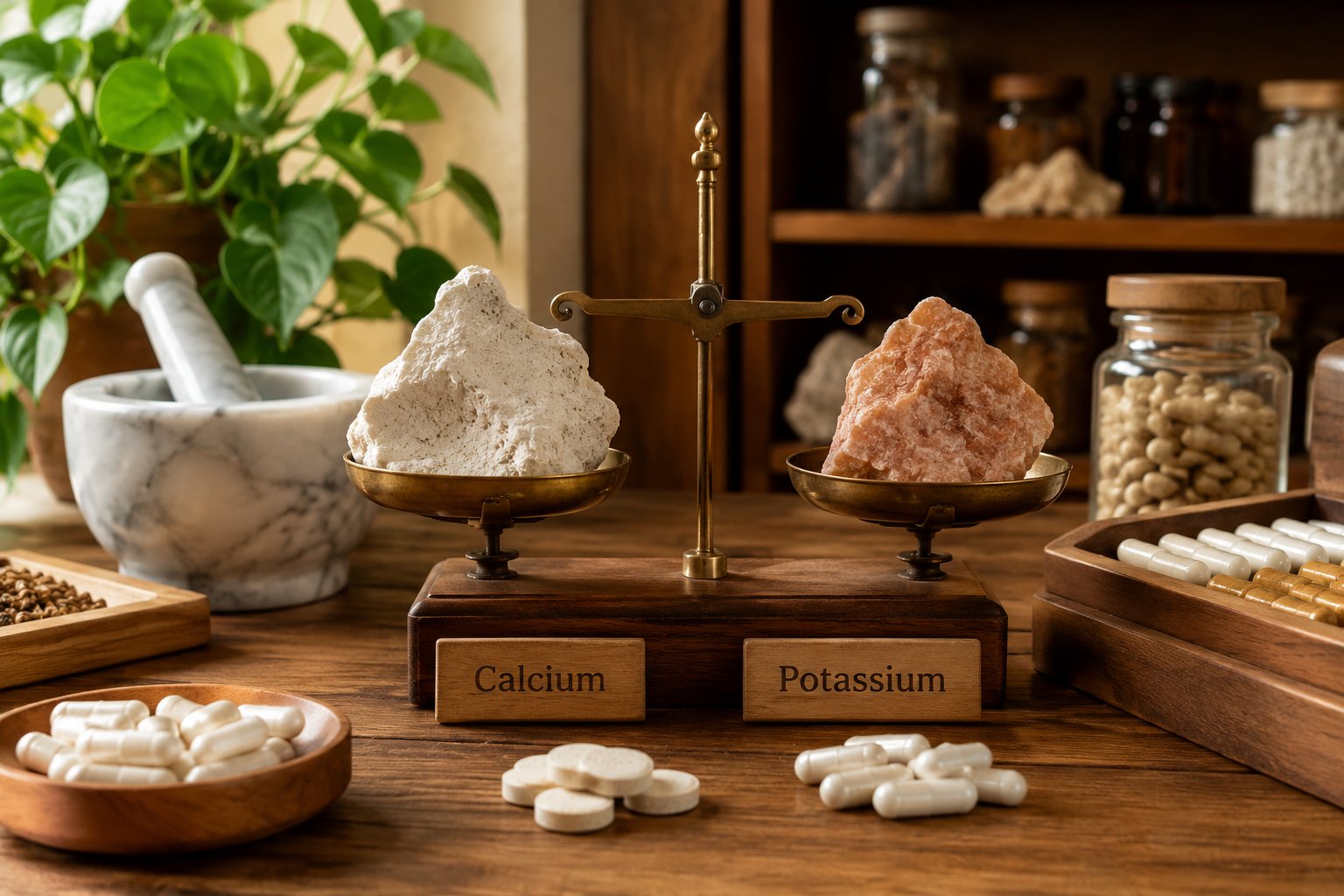

Some mineral patterns describe what a body is running low on. The calcium shell describes something stranger and more human: what a body does when it has decided the world is too much. On a hair tissue mineral analysis it appears as tissue calcium climbing far above the ideal — and in the person sitting across from me, it almost always appears as someone who has stopped feeling like themselves and cannot explain why.
What the Shell Is
Calcium’s day job is structure — bones, teeth, the scaffolding of the body. But under long, unrelenting stress, calcium begins accumulating in the soft tissues, and mineral practitioners have long described the result exactly the way it behaves: a shell. A wall built from the inside, brick by mineral brick, between the person and a world that has demanded too much for too long. On the report it is a number. In a life, it is armor that went up for good reasons and then refused to come down.
How a Shell Gets Built
The construction schedule is chronic stress. In the early stages of the stress response the body spends its fast-acting minerals — sodium and potassium run high while the system fights. Stay in the fight long enough and the pattern inverts: the fast minerals deplete, the metabolism slows to conserve what is left, and calcium settles into tissue like sediment in still water. The shell is a late chapter in the stress story — what the body builds when sprinting failed and it has committed to a siege.
What It Feels Like From the Inside
People carrying this pattern describe life through glass: emotions muted, joy and grief both arriving at half volume, motivation flattened, the world slightly far away. Fatigue is constant but different from the wired exhaustion of early stress — this is heavy, insulated tiredness. Practitioners who read these studies associate the pattern with exactly that report, and the phrase clients use is remarkably consistent: I feel numb. It matters to say plainly that the shell is a wellness pattern, not a diagnosis — but for the person living inside one, seeing it measured on paper is often the first time their numbness has ever been taken seriously by anything.
What I See When a Shell Starts to Come Down
A perspective from my own practice, because this pattern rewards patience like no other. The shell went up slowly and it comes down slowly — and the coming down is not always comfortable. As tissue calcium mobilizes over months of correct support, feelings return before comfort does: clients report crying at commercials, laughing too loudly, being suddenly angry about things they had been calm about for a decade. I warn every shell client about this in advance, because without warning it feels like getting worse. It is the opposite. The armor is coming off, and skin that has been under armor is tender at first. A few retests later, the same client sits across from me describing colors as brighter — their phrase, not mine — and that conversation is one of the privileges of this work.
Softening the Shell
The approach is a program, not a supplement — and emphatically not a calcium question alone. Correction runs through the whole pattern: rebuilding the depleted companion minerals in ratios a trained practitioner designs from the actual test, supporting the slowed metabolism gently rather than whipping it with stimulants, and — non-negotiably — addressing the stress the shell was built against. Minerals loosen the bricks; a life that no longer requires armor is what keeps the wall from going back up. Retesting every three to five months turns the whole process from faith into measurement; I covered why that retest rhythm matters separately.
Where This Framework Comes From
The calcium shell, oxidation types, and the stress-stage model of mineral patterns come out of decades of clinical work — the research lineage of Dr. Paul C. Eck and Dr. David Watts of Trace Elements Inc., whose laboratory work made tissue mineral patterns practically readable. If the pattern in this article sounds like your last several years, the starting point is seeing your own numbers: a hair analysis with professional interpretation shows whether a shell is present and how thick the walls have gotten, and my earlier comparison of HTMA and blood testing explains why routine blood work almost never sees this pattern at all.
The Company a Shell Keeps
The calcium shell rarely travels alone. On the same report it typically rides with slow oxidation — the banked-fire metabolism of a body in conservation mode — and often with the four-low electrolyte pattern or a magnesium level dragged along by calcium’s climb. The companions matter because they explain the whole person: the shell accounts for the numbness, the slow oxidation for the heavy fatigue and cold hands, the depleted electrolytes for the missing spark. Reading them together is why a trained interpretation outperforms staring at any single number — the report is a weather system, not a thermometer.
Living Alongside the Correction
The mineral program does its work over months, and daily life either helps it or fights it. Helping looks unheroic: protected sleep, because the shell was built against exhaustion and rebuilds fastest in its absence; gentle movement — walking, easy mobility work, warmth — rather than punishing exercise, which a conservation-mode body reads as more siege; and the deliberate practice of lowering the guard in safe places, since the shell has a psychological architecture as real as its chemistry. Clients who pair the program with even one genuine change to the load — a boundary, a delegation, a resignation from an unpaid war — consistently outpace the ones who only take the minerals.
What a Retest Arc Looks Like
The first retest, three to five months in, usually shows movement rather than resolution — tissue calcium beginning its descent, companion minerals starting to refill, and sometimes a temporary reshuffling as the body spends what it is finally willing to release. The second retest is where trends earn trust. I coach people to judge the arc, not any single report: a shell that took a decade of siege to build coming down across a year of retests is not slow progress. It is the fastest honest schedule there is.
Frequently Asked Questions
Can the shell pattern show up in children or teenagers?
Mineral patterns appear at every age, and practitioners do see defensive patterns in young people carrying heavy loads — though interpretation in children is its own specialty and belongs in experienced hands. The more useful family takeaway: the conditions that build shells are household conditions, and the changes that soften them tend to benefit everyone under the same roof.
I recognize myself in this article. What is the actual first step?
Get the pattern measured before acting on it — self-diagnosing from an article is exactly the guesswork mineral testing exists to replace. A hair analysis with professional interpretation confirms whether a shell is present, how it sits among its companion patterns, and what sequence of support fits your actual chemistry rather than the average reader’s.
Isn’t high calcium a good thing?
In bone, yes. The shell is calcium in the wrong compartment — accumulating in soft tissue while, often enough, the bones are not the beneficiary. Location is everything; more is not better when it is bricked into places designed for flexibility.
My blood calcium is normal. How can my tissue calcium be high?
Blood calcium is among the most tightly defended numbers in the body — it barely moves even while tissue behavior changes dramatically. The two tests measure different compartments, which is precisely why the shell hides from standard lab work.
How long does a shell take to come down?
Patterns built over a decade do not dissolve in a month. Most people work in retest cycles — three to five months apart — and watch the trend across several of them. Individual, always; slow and measurable, reliably.
Is the emotional flatness really connected to a mineral?
The association between this pattern and muted feeling is one of the most consistent clinical observations in mineral work, though the connection runs both directions — stress builds the chemistry and the chemistry sustains the state. Treat the correlation as a map for investigation with a practitioner, not a mechanical certainty.
Can the shell come back?
Yes — the same siege conditions rebuild the same wall. The lasting fix pairs the mineral program with real changes to the load: sleep, boundaries, recovery practices. The retest is your early-warning system either way.
The full mineral-pattern library — oxidation types, key ratios, the four-low pattern — lives on the HTMA & Personalized Nutrition pillar.