
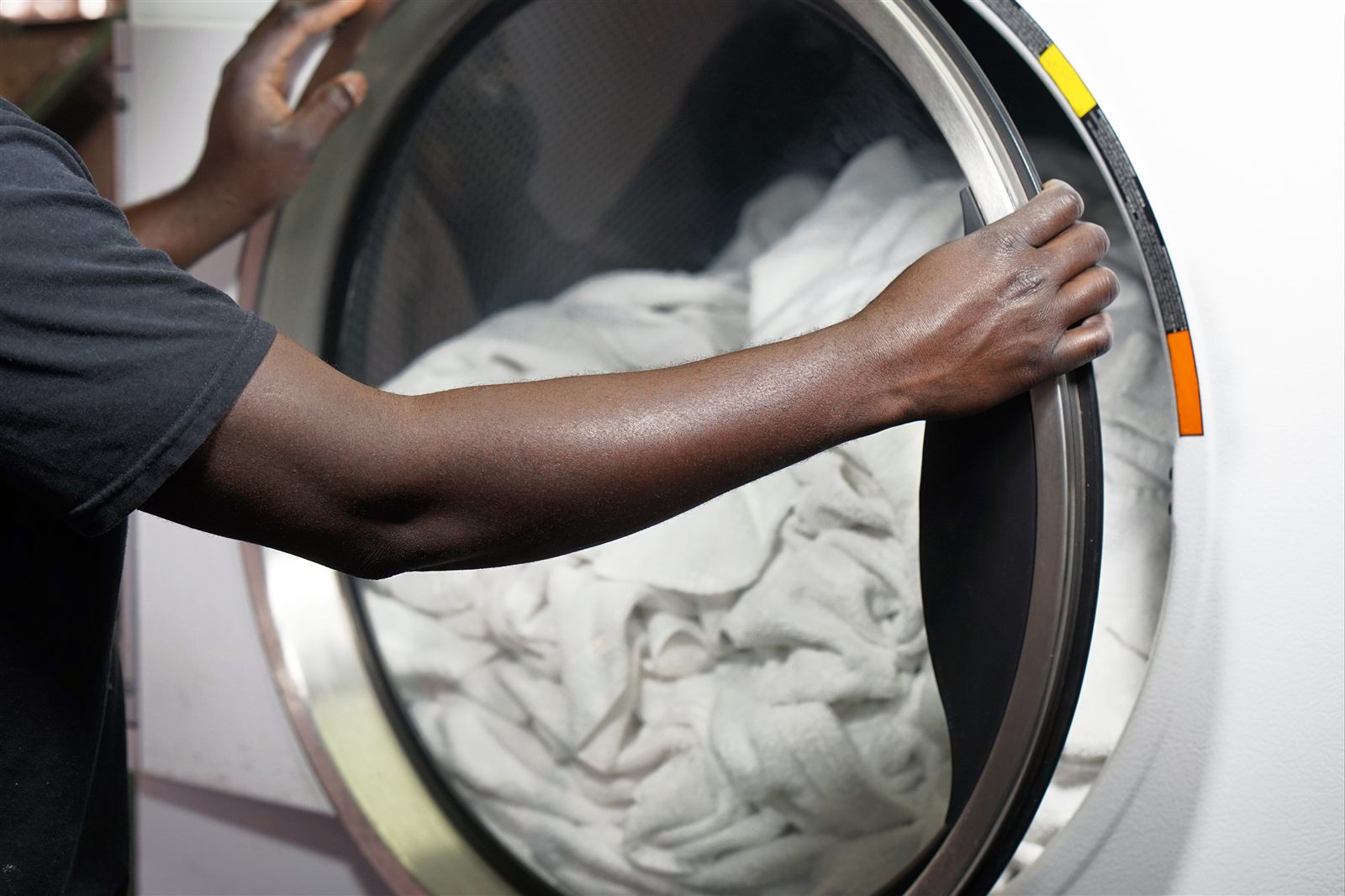
You spend serious thought on what goes in your body and what goes on your skin. Meanwhile, the largest continuous skin contact you have all day — roughly every waking and sleeping hour — is with fabric that came out of your washing machine carrying whatever your laundry products left behind. After I overhauled my kitchen, the laundry room was the obvious next audit, and it turned out to need one just as badly. Five swaps, each done once, quietly lowered the chemical load my family wears around the clock.
Your Clothes Are an All-Day Skin Patch
Skin absorbs a meaningful share of what sits on it — the principle behind every medicated patch, and the reason what you feed your skin matters. Laundry residue is engineered to sit on fabric: optical brighteners, fragrance compounds, and softening agents are designed to survive the rinse and stay in the fibers, where warmth and moisture from your body keep the exchange going all day. No single exposure amounts to much. Wearing it twenty-four hours a day for decades is a different arithmetic.
Swap 1: The Fragranced Detergent
Fragrance is the biggest single lever, because “fragrance” on a label is a sealed box that can legally contain dozens of undisclosed compounds, phthalates among the common ones. A fragrance-free detergent with a short, pronounceable ingredient list washes clothes exactly as clean — cleanliness never had a smell. Expect a strange week where laundry smells like nothing; that is what clean actually smells like, and it grows on you fast.
Swap 2: Dryer Sheets and Fabric Softener
Softeners work by coating fibers with a film — the very film your skin then spends the day against, and one that also degrades towel absorbency and athletic-wear performance. Wool dryer balls soften mechanically instead of chemically, cut drying time somewhat, and last for years. A half-cup of plain white vinegar in the rinse compartment handles static and stiffness; the smell is gone by the end of the cycle.
Swap 3: Chlorine Bleach
Chlorine bleach earns its keep in genuine sanitizing emergencies, not weekly whites. Oxygen bleach — sodium percarbonate, essentially powdered peroxide — brightens without the fumes or the residue, and sunlight remains the most underrated whitener ever invented: an afternoon on a line does what an extra rinse cycle cannot, for free.
Swap 4: What Touches Skin All Night
Prioritize by contact hours. Sheets, pillowcases, underwear, and sleepwear log more skin time than anything else you own — they deserve the cleanest wash and, when replacement time comes, natural fibers. Cotton, linen, and bamboo breathe and release moisture; synthetics hold both warmth and whatever chemistry they were finished with. You do not need to replace a wardrobe — just let the next set of sheets be the good kind, washed the new way before first use, which is a habit worth extending to every new garment you buy.
Swap 5: The Dry-Cleaning Habit
Conventional dry cleaning can leave solvent residue in fabric — that chemical smell on fresh dry cleaning is the product, not the process. Air anything dry-cleaned outside its bag for a day before it enters the closet, question how many “dry clean only” labels really mean it (many knits and wools hand-wash beautifully), and if your area has a liquid CO2 or wet-cleaning shop, they solve the problem at the source.
The Order I Did It — and What I Noticed
My audit ran on contact hours: detergent and sheets first, dryer sheets the same week, bleach and dry cleaning whenever the old supplies ran out — the whole conversion cost one shopping trip and zero willpower after that. What I noticed took about a month to trust: the faint end-of-day itch along waistbands and sock lines that I had never thought to attribute to anything simply stopped, and towels started actually drying us again. When I walk clients through the Eileen Durfee Method’s home-environment work, laundry is the swap set I assign first now — not because it is dramatic, but because it is the rare change you make once and then wear, every hour, for the rest of your life.
What Not to Worry About
Perfection is not the assignment. The occasional hotel laundry, a borrowed towel, the one jacket that truly needs the dry cleaner — none of it moves the needle against a baseline you have already fixed. Chemical load is cumulative, which cuts both ways: the everyday exposures you eliminated do the heavy lifting, and the exceptions stay exceptions.
The Towel Test
Want proof the old products were leaving something behind? Run the towel test. Wash your least absorbent towel — the one that pushes water around instead of drinking it — twice with fragrance-free detergent, a half-cup of vinegar in the rinse, and no softener of any kind. Then use it. The absorbency that returns was there all along, buried under accumulated softener film. Towels are simply where the coating is easiest to feel; the same film was on everything else, including the sheets you sleep in and the shirt against your back right now.
Reading a Detergent Label in Thirty Seconds
You do not need a chemistry degree — three checks do the sorting. First: the word “fragrance” or “parfum” anywhere on the list is a pass, full stop, since it is the one ingredient allowed to be a sealed box. Second: shorter lists win; a workhorse detergent needs surfactants and enzymes, not thirty entries. Third: “free and clear” is a start, not a guarantee — a few brands pair the label with dyes or preservatives that defeat the point, so give even the virtuous bottle its thirty seconds. Once you find the brand that passes, the label reading is over forever; loyalty is the reward for one good audit.
One Room Funds the Next
Something I have watched in my own house and in every client who starts this work: the momentum compounds. The kitchen audit made the laundry audit obvious; the laundry audit makes the bathroom cabinet impossible to ignore, and by then the household’s default question has quietly flipped from “does this product work?” to “what does this product leave behind?” That single question, applied at normal shopping speed with zero heroics, renovates a home’s chemical load in about a season. Start with whichever room bothers you most — the order matters far less than the momentum.
Frequently Asked Questions
Are ‘free and clear’ dryer sheets an acceptable compromise?
They remove the fragrance problem but keep the film problem — the softening still works by coating fibers with chemistry your skin wears afterward. Wool balls plus the vinegar rinse make the compromise unnecessary, which is why I treat fragrance-free sheets as a stepping stone rather than a destination.
Does water temperature matter for getting old residue out?
Warm water rinses accumulated buildup out of fabric more effectively during the transition — running the first cycle or two of the new routine warm helps strip what previous products left behind. After that, cold works fine for most loads and is gentler on both fibers and the power bill.
Do laundry chemicals really absorb through skin?
Fabric residue transfers to skin with warmth, moisture, and friction — the conditions your body provides all day. Absorption varies by compound; the practical point is that this is your largest and longest daily contact surface, and it is fully under your control.
Can I just add essential oils to an unscented wash?
You can, though most people stop missing scent within weeks. If you do, add a few drops to the wool dryer balls rather than the wash water — less product, gentler on skin, and you control exactly what is in it.
What about baby clothes?
Everything here goes double — more skin per pound, more fabric contact, and developing systems. Fragrance-free detergent and a pre-wash for anything new are the standard advice from pediatric sources for good reason.
Why wash new clothes before wearing?
Garments ship with finishing chemistry — anti-wrinkle and anti-mildew treatments applied for the journey from factory to shelf. One wash in your clean routine removes most of it. That new-clothes smell is not the fabric.
How do I handle static without dryer sheets?
Wool balls plus the vinegar rinse solve most of it; over-drying causes the rest, so pull loads a few minutes earlier. Static clings hardest to synthetics — one more quiet vote for natural fibers.
The room-by-room version of this project — kitchen included — lives on the Environmental Wellness pillar, alongside the five kitchen swaps, and the free Healthy Home Detox Checklist turns the whole house into a weekend punch list.