
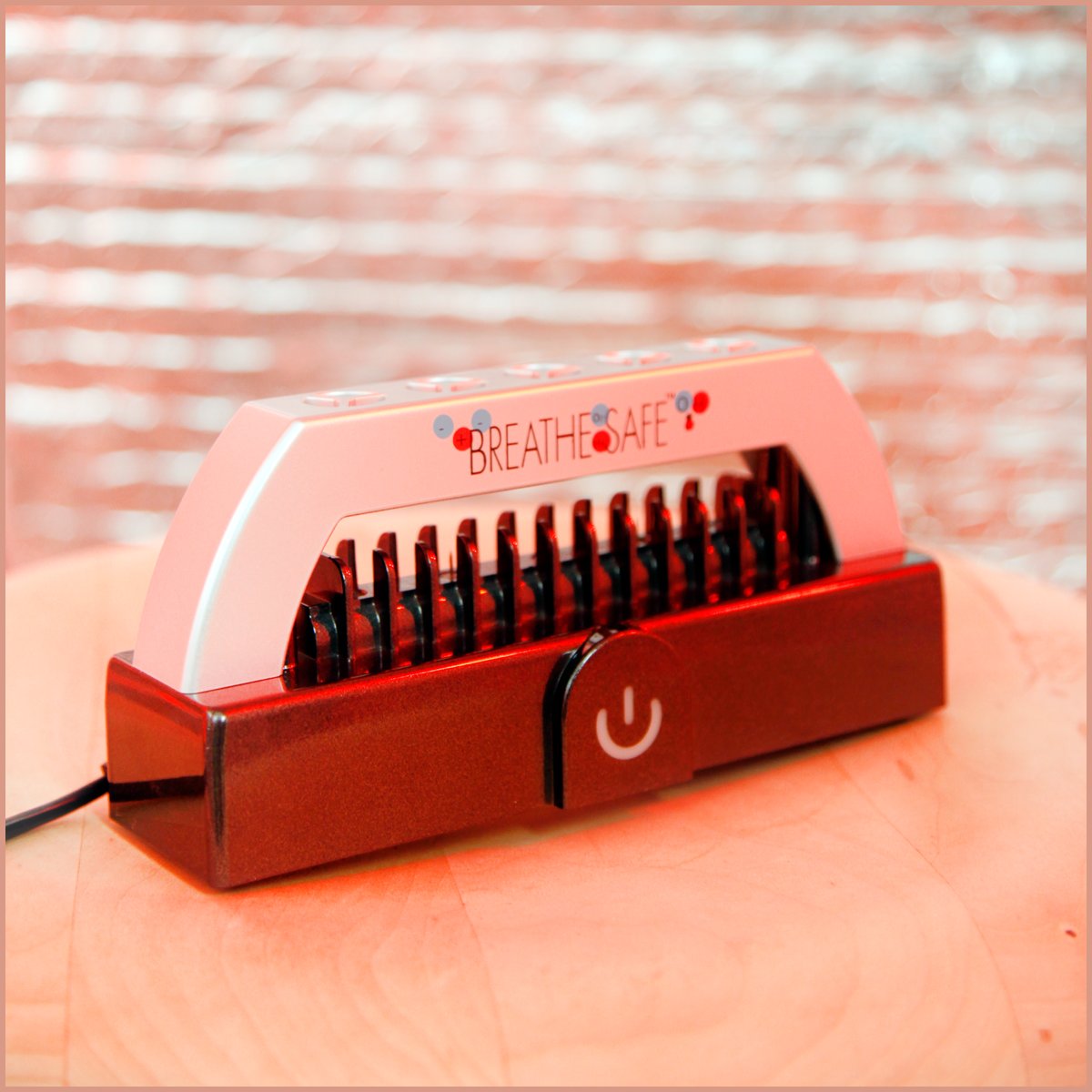
U.S. patent 10881757, the Plasma Air Purifier, was granted January 5, 2021 for a portable device that produces positive and negative ions at the same time: a discharge plate makes the negative ions and a discharge needle array makes the positive ions. I sell the device as the Breathe Safe, and the same invention is patented in China, Canada and Australia. Chapter 4 of my book Invent It and Be Your Own Boss lists 14 components and features of this patent; this article explains how those parts produce, control and release the ions, and which parts exist for safety.
The Ion-Producing Parts
The housing is the outer casing, and it holds 4 parts: the discharge plate, the discharge needle array, the microcontroller and the power supply. The discharge plate, mounted onto the housing on at least 2 pillars, generates negative ions when powered and creates the electric field required for ionization. The discharge needle array is a base plate carrying multiple metallic needles, connected to the microcontroller, and it produces positive ions when powered; Chapter 4 states that the orientation and distribution of the needles maximize the emission area for positive ions, and a strip of static tape reinforces the connection between the array’s base plate and its receptacle base. The fins and the 2 sets of pillars hold the needles and the discharge plate at an arcing distance from each other, which is the spacing that creates the electric field for ionization.
The Control and Power Parts
The microcontroller controls 2 outputs: the emission of positive and negative ions, and the electrical current sent to the discharge needle array. A pressure-sensitive button lets the user cycle through the emission modes, and a visual indicator shows the mode selected. The power supply feeds the microcontroller, the discharge plate and the needle array; the patent describes power from a wall outlet through a cord, and names a portable battery as the preferred source, with a rechargeable battery or a battery pack connected to an outlet as 2 alternatives. The patent abstract adds 1 wiring detail: the needle array draws its power through the microcontroller.
The Release Parts
The cover surrounds the needles and the discharge plate and has central ventilation holes for ion dispersion into the room air. Vents in the cover let the positive and negative ions move freely into the surrounding air. In an alternate embodiment, fans controlled by the microcontroller spread the ions further into the air. The cover can also attach to other units, so 2 or more devices stack for more air purification.
The 4 Contact-Safety Parts
Chapter 4 describes 4 parts that keep the user from touching charged components. Part 1 is the cover, which keeps the user from touching the needles and the discharge plate while leaving the unit easy to handle. Part 2 is the set of fins, which also protect the user from needle contact. Part 3 is the slot-covering plate, which covers the slot and the base plate of the needle array, so the charged base plate cannot be touched while ions still pass out through the needle holes. Part 4 is the set of electrically insulative spacers, which secure the needles in their holes and block accidental contact with the charged needles.
Why a Combination of Known Parts Was Patentable
Chapter 4 uses this patent as its example of a unique combination. It describes all 14 parts and how each connects, and states that the individual elements may not be novel while their assembly and interaction in 1 compact, portable unit make the invention unique. The filing path ran from a provisional application on July 17, 2015 to a Patent Cooperation Treaty (PCT) application on July 23, 2015, then a PCT continuation-in-part and a U.S. utility application.
The Design Requirement Behind It
The Breathe Safe design came from 2 sources recorded in the book. The idea came to me on an airplane, surrounded by coughing and sneezing passengers: a compact, battery-powered purifier for personal space. The design requirement came from ozone measurements: a customer who measured ambient ozone at work showed me that corona-discharge ozone generators emitted unsafe ozone levels almost immediately, and my first-generation REION exceeded acceptable ozone limits on its plasma setting within a 5-foot radius. I revised the REION owner’s manual and designed the Breathe Safe as a plasma air purifier with no ozone emission. Chapter 2 records the tests I ran on it: its negative and positive ion output, and its reduction of volatile organic compounds (VOCs), particles, bacteria and other unwanted molecules in the air. Chapter 2 also classifies the Breathe Safe as a personal space air purifier, with a claim limited to air purification.
Keep Exploring
This article is for educational purposes only.