

Restoring a cervical curve takes 12 weeks at Stage 1 of the 5 stages of degeneration in my book, Spinal Fitness. Stages 2 and 3 take longer, and the added time depends on the health of the discs. At Stage 4 a partial restoration of the shape is possible. At Stage 5 the fused segment keeps its fused shape, and the work moves to the segments above and below it.
Why the answer depends on the disc
Chapter 4 of the book describes a pumping action in the cervical disc. With a normal curve, each small movement of the head produces alternating compression and decompression across the disc, and that cycle moves fluid and nutrients in and waste out. When the curve flattens, the disc sits under more constant compression, the pumping action declines and hydration falls. The time to restore the curve therefore depends on the stage, and at Stages 2 and 3 it depends on the health of the discs.
The 5 stages and the time at each
Stage 1 of 5: healthy disc, hydrated. The disc is intact, the pumping action is active and disc height is normal. My figure for this stage is 12 weeks.
Stage 2 of 5: early degeneration, loss of hydration. The curve has begun to flatten, the pumping action is impaired, and disc height may be slightly reduced. The book lists occasional stiffness, tightness, headaches and fatigue at this stage. The time is longer than 12 weeks, and the amount of hydration the disc has kept sets how much longer.
Stage 3 of 5: advanced degeneration, disc collapse. Sustained compression has collapsed the disc space significantly, nutrient supply to the inner disc is compromised, and the facet joints carry load beyond their intended role. The time is longer again than Stage 2, for the same reason: disc health.
Stage 4 of 5: bone-on-bone changes. The disc space is severely narrowed and the facet joints have remodeled. A partial restoration of the shape is possible. The book states the goal at this stage as 4 items: reduce irritation, improve available motion, unload what can be unloaded, and protect the segments above and below.
Stage 5 of 5: fusion of the segment. The vertebrae have fused, and the fused segment has 0 degrees of motion. The segments above and below keep their mobility, and the book states that restoring the overall cervical curve can still reduce the load on those adjacent levels.
The force numbers behind the 12 weeks
Dr. John Scherger’s analysis in the book models the head as a 4-kilogram resistance in 3 postures. With proper lordosis the neck carries 32 lb of effective head load. A straight neck carries 64 lb. Forward head posture carries 117 lb. The head weighs the same in all 3 postures, and the lever arm is what changes. The difference between forward head posture and proper lordosis is 85 lb of effective load on the discs and the posterior muscles.
What the daily work is
The book’s Step 4 is Neck Flexion, a nod against light resistance at the front of the head, with the neck hinging near C5. The beginner dose is 6 repetitions per session, 6 sessions per day, with muscular strain and 0 pain. When 6 repetitions no longer produce strain, the dose rises to 10 repetitions per session. The book states that 6 repetitions 6 times a day produce better results than occasional high-volume sessions, because postural adaptation responds to cumulative stimulus. On long sitting days I do about 10 repetitions with the Neck Shaper at every bathroom, food and water break.
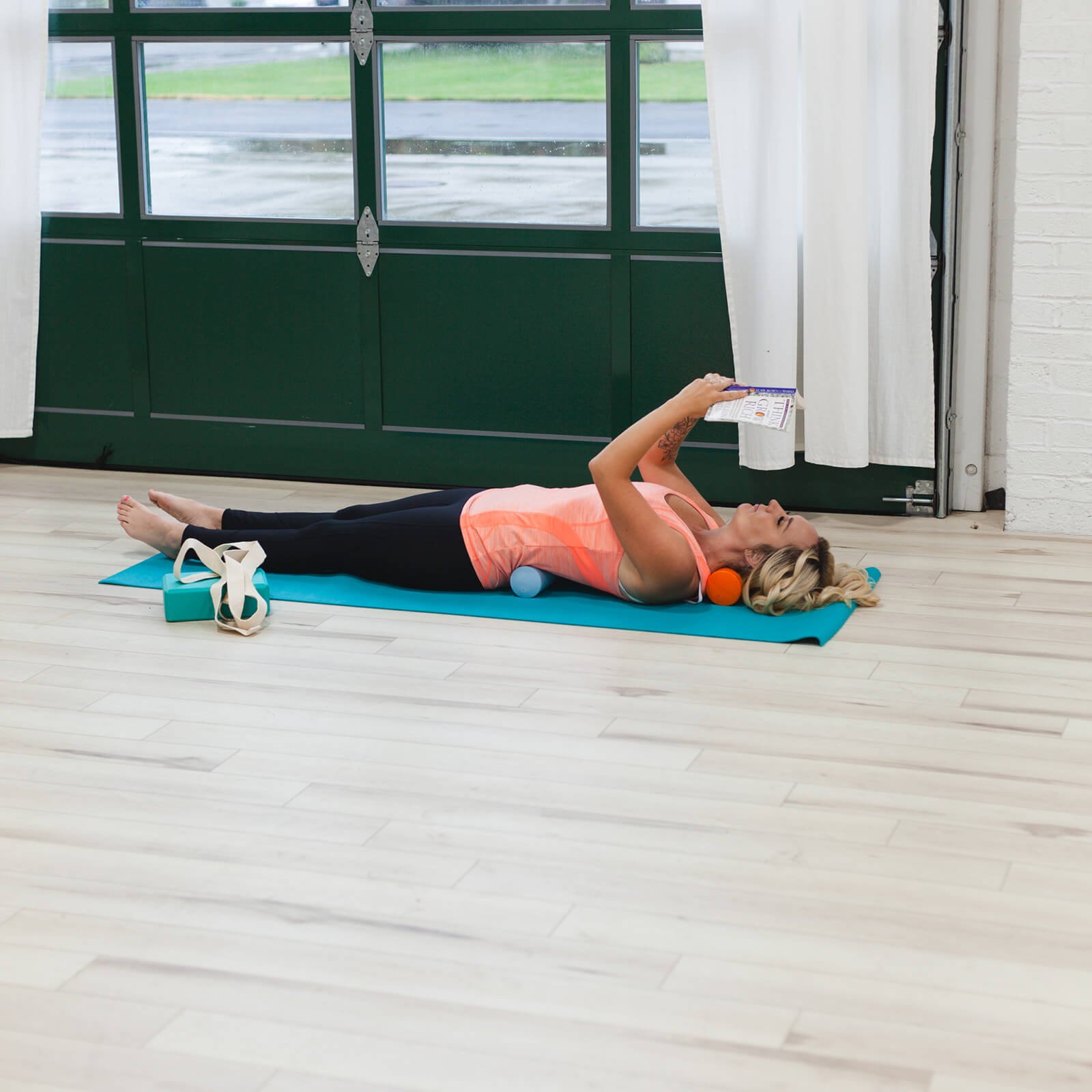
Rolling is the second input. The Back Trac and the Neck Shaper rolls apply segmental traction with body weight, in 5 diameters and 3 densities, starting with the softest density.
How the stage is identified
Disc height, facet changes and fusion are read from imaging, and the stage follows from those 3 findings. At my Kennewick center the 60-minute Spinal Fitness evaluation includes a Posture Screen software scan and a printed report, and a repeat screen is a second report to set beside the first.
Stop signs
The book lists pain, numbness, tingling and dizziness among its stop signs. They are signs to stop, get evaluated, and proceed with a therapeutic exercise program designed by a Spinal Fitness expert. The book adds 2 rules for the neck: range of motion is never forced, and a beginner may move only 1 or 2 inches at first.
Keep Exploring
This article is for educational purposes only.