

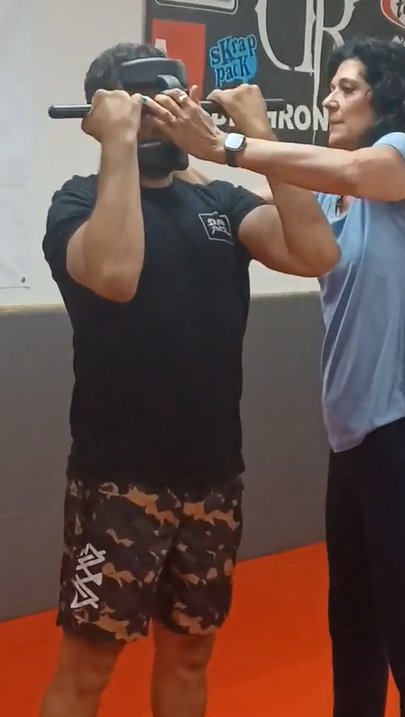
Each inch the head moves forward of the shoulders adds about 10 pounds of effective load to the cervical spine, according to my book Spinal Fitness. A seated workday produces that forward drift in a fixed order: the pelvis rolls back, the lumbar curve flattens, the thoracic spine rounds, and the head moves forward. On long sitting days I interrupt that position with neck flexion on the Neck Shaper, about 10 repetitions at a time.
What sitting does to the load on the neck
The book gives three head-load figures by posture, drawn from Dr. John S. Scherger’s mechanical analysis: a neck with proper lordosis carries 32 pounds of effective head load, a straight neck carries 64 pounds, and a forward-head posture carries 117 pounds. For the 117-pound figure, the book’s line is: “The head did not become heavier. The leverage changed.”
The book also totals the cost over an 8-hour shift for a 4-kilogram head. With proper posture, joint strain adds up to 18,048 kilograms over 8 hours; with the head forward it adds up to 35,904 kilograms. Muscle effort rises from 6,336 kilograms to 26,736 kilograms. The book calls the joint figure “nearly double” and the muscle figure “more than four times the muscular cost.”
The book’s sentence on sitting: “Sitting in poor posture is not doing nothing. It is sustained mechanical work in a poor leverage position.”
Why the discs need the position to change
The book describes the intervertebral disc as living tissue that needs nutrients in and metabolic waste out. After early adulthood, discs rely on mechanical motion for that exchange, and the process is osmotic: “Compression squeezes fluid out of the disc. Decompression draws fresh fluid back in.” A cervical spine with a healthy curve keeps that exchange going through small movements of the head and neck across the day.
A held seated position removes the compression and decompression cycle. The book states that “sitting reduces normal movement-based disc hydration and creates stiffness cycles,” and that a disc under sustained pressure, without periodic relief, loses hydration over time, and disc height decreases. The healthy cervical facets also split force into a compressive part and a small upward lift, which the book calls the floating mechanism; a lost or straightened curve removes that lift.
The dose the book gives for a desk day
The book’s Desk Standard has four parts:
- Prime (2 to 4 minutes, at the start of the day or the first break): neck flexion, 6 repetitions, strain without pain.
- Micro-breaks (10 to 30 seconds, every 45 to 60 minutes): 2 to 3 neck flexion repetitions, standing and a brief walk, and a rib-over-pelvis reset.
- Reset (mid-shift, 3 to 5 minutes): the sit-up over the PowerCushion, 6 to 10 repetitions at light density, and 1 to 2 minutes of Back Trac rolling.
- Decompress (end of the day, 15 to 20 minutes at home): 25 spinal twists, then the Neck and Back Shaper roll rest.
For neck flexion itself, the beginner dose is 6 repetitions per session, 6 sessions per day. The progression is to 10 repetitions once 6 no longer produce strain. The book states that “Micro-dosing (6 reps, 6 times per day) produces better results than occasional high-volume sessions.”
My breaks, and the Neck Shaper
My rule on long sitting days is tied to breaks I already take: every bathroom, food or water break, I stand and do neck flexion with the Neck Shaper, about 10 repetitions each time. That puts the exercise into the day several times without a timer, at the 10-repetition level the book reaches after 6 repetitions stop producing strain.
The Neck Shaper is 7 inches long and comes in diameters of 2.75, 3.0, 3.25, 3.5 and 3.75 inches, with a center groove so the spinous processes are not pressed into the support. The book’s Method B uses the Neck Shaper with the same mechanics as the hands-only version.
Where the curve is lost first
The book places the source of the seated chain at the pelvis, not the chair: Dr. Scherger’s approach “addresses the source: the pelvis.” Its order of correction is pelvis before spine before head, and the desk micro-break includes a rib-over-pelvis reset for that reason. The book’s visual check for the neck is the ear stacked over the shoulder with a visible cervical lordosis; from the side, the ear, shoulder and greater trochanter of the hip line up. The 3 patterns it screens for are a forward head, a flattened lumbar curve, and trunk mass sitting forward of the hips.
How the movement is done
The book teaches neck flexion as a hinge at C5: “nod toward someone as if you’re agreeing with them.” The cues are “Nod, don’t push,” “Ribs down, shoulders soft,” and “Stop early, reset back.” On the clock-face cue, the nose starts at 12 o’clock and nods to about 3 o’clock to 3:30, and then the head is pushed straight back. Beginners may move only an inch or two at first, and the face and neck are never shoved forward.
The book’s target for each repetition is muscular strain without pain, and its stop signs for this exercise are pain, numbness, tingling, dizziness, visual changes and headache spikes. Any one of them is a sign to stop, get evaluated, and then proceed with a therapeutic exercise program designed by a Spinal Fitness expert.
Keep Exploring
This article is for educational purposes only.