
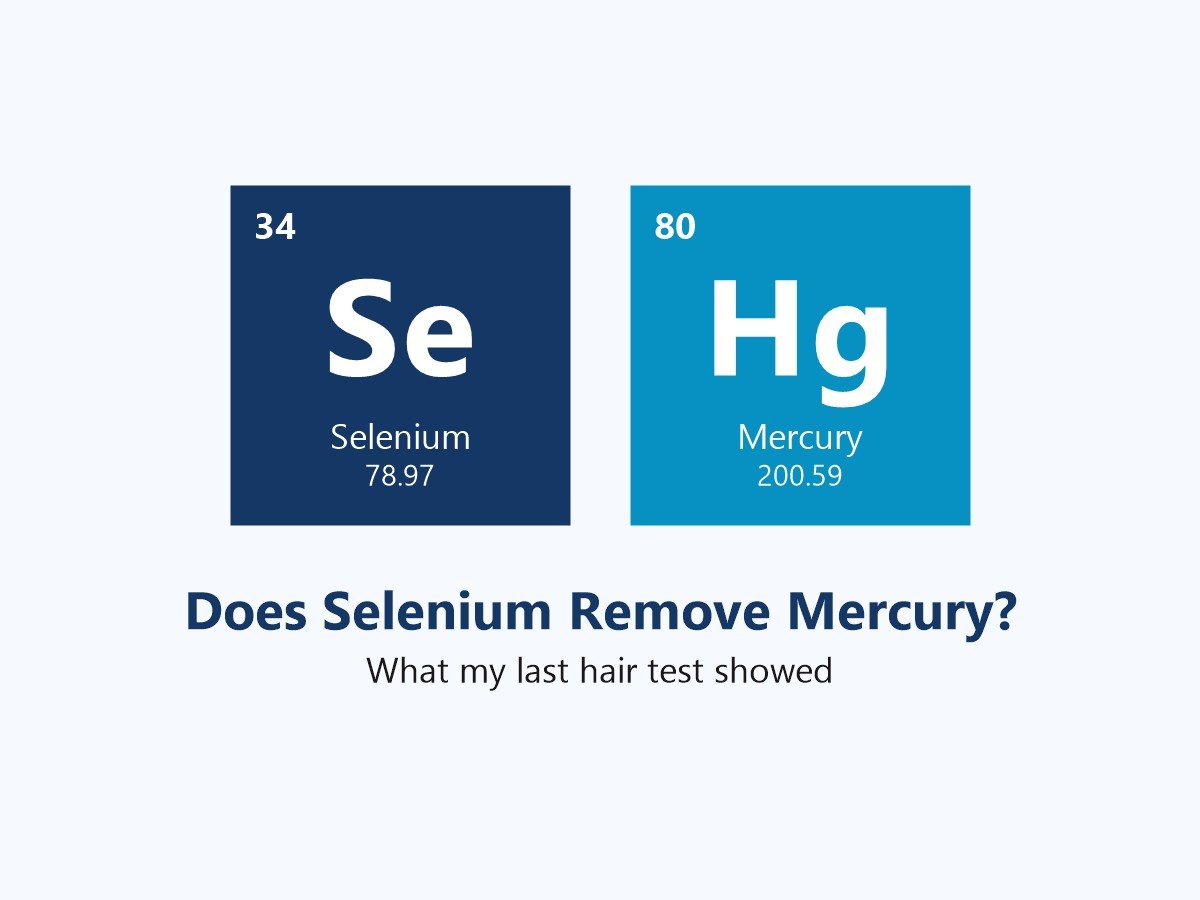
Selenium binds mercury in the body, but in the toxic-metals research that Analytical Research Labs (ARL) relies on, selenium given during mercury exposure delayed toxicity without increasing the amount of mercury excreted. On my last hair test, mercury and selenium both went up. I had my silver amalgam fillings removed in 1984, and I had been eating more fish, which is the most likely source of both readings.
What my two readings were showing
Trace Elements, Inc. (TEI) sets the upper limit for hair mercury at less than 0.10 mg% and puts the ideal hair selenium at 0.08 mg%. TEI also judges mercury against its antagonists, not only by its own level: the minimum Se/Hg ratio is 0.8 to 1, the minimum Zn/Hg ratio is 200 to 1, and the minimum Fe/Hg ratio is 22 to 1. TEI states the principle with lead: “A ratio below 84:1 would indicate a potential toxicity of lead, even if the lead is within an acceptable level.” The mercury ratios are read the same way.
Seafood is listed among the good food sources of selenium in TEI’s selenium material, along with kidney, liver, meats and poultry. Tuna, swordfish, shark and tilefish are listed among the main mercury sources, with concentration rising with fish size, up the food chain. One change in my diet, more fish, fits a rise in both elements on the same chart.
Why the amalgam history matters on a hair test
ARL lists silver amalgam fillings as about 50 percent mercury, with older fillings carrying more. Amalgam mercury leaches and vaporizes, and cracked fillings add to the exposure. ARL also states that sequestered mercury remains in storage for years: in acute poisoning, mercury excretion runs about 1 percent per day, and that rate does not apply to mercury already held in tissue. Mercury’s main target organ is the kidney, and in postmortem samples from mercury mine workers in Yugoslavia, the highest concentrations were in the thyroid and pituitary glands.
So a mercury reading years after amalgam removal has two possible readings. ARL’s retest rule is that a higher toxic metal on a retest usually means a metal is being actively eliminated, not that toxicity has worsened. A new dietary source is the other possibility. My chart came with a known change in intake, and that is how I read it.
Two forms of mercury, two absorption rates
ARL states that only 7 percent of ingested inorganic mercury is absorbed, compared with at least 95 percent of ingested methylmercury, the form found in fish. Hair mercury runs about 300 times higher than blood mercury (Prasad, 1976), and ARL notes that segments of a hair sample can give a chronological account of mercury excretion. Each hair reading averages 2 to 3 months of growth, so a retest 3 to 5 months after a change in diet shows whether mercury followed the change.
ARL’s dietary limit is tuna not more than 2 times a week, with albacore listed as safer than the larger tuna species.
What selenium does with mercury
The selenium research summarized by ARL has three findings:
- Selenium forms complexes with mercury. Selenium protects against methylmercury and other forms, and the selenium in tuna protects against the tuna’s own mercury.
- Selenium relocates mercury. Selenium decreased kidney mercury but increased mercury deposition in the liver and brain.
- Selenium does not raise excretion. Selenium and cysteine both delayed toxicity when given at the same time as mercury, and neither increased fecal or urinary excretion. Selenium given after exposure “probably cannot increase elimination.”
Watts (TEI) lists mercury, cadmium, silver, arsenic and thallium as selenium antagonists (Ganther), with the note that selenium binds mercury and cadmium and renders them less damaging without increasing their excretion. TEI judges mercury against selenium at a minimum Se/Hg of 0.8 to 1.
What does move mercury out
ARL names the bile as the preferred excretion route for mercury, and lists vitamin C, selenium, kidney glandular support, and liver support from sulfur, inositol, choline, methionine and copper among the nutrients used during a mercury elimination. Zinc induces metallothionein, which complexes with mercury (Bremmer, 1976), and TEI names zinc as the first nutrient against excess of most zinc antagonists, lead, cadmium and mercury included. ARL’s 4 simultaneous mechanisms of metal removal are increased biochemical energy production, chelating agents such as vitamin C and sulfur-containing amino acids, antagonistic elements, and support of the eliminative organs.
ARL adds a sequence observation: mercury inhibits copper absorption from the intestine, yet people with mercury toxicity often later display copper toxicity, and copper elimination symptoms commonly follow as mercury leaves. A retest after a mercury rise is therefore read for copper and the Zn/Cu ratio as well, with both labs placing the ideal Zn/Cu at 8. Mercury also raises the sodium reading, so the adrenal ratio is read with that in mind.
Keep Exploring
This article is for educational purposes only. These statements have not been evaluated by the Food and Drug Administration.