
Most people think of a sauna as a place to sweat. Sweating matters — it is one of the body’s most efficient elimination routes — but if that is all you know about near infrared light, you are missing the more interesting half of the story. Near infrared (NIR) wavelengths interact with your cells in ways that ambient heat alone never can, and understanding the difference explains why a near infrared lamp sauna feels so different from sitting in a hot room.
Light Your Cells Can Actually Use
Near infrared light occupies the part of the spectrum just beyond visible red — roughly 700 to 1,400 nanometers. Unlike far infrared, which is absorbed mostly at the skin’s surface as heat, near infrared wavelengths penetrate several inches into soft tissue. There, they reach structures inside your cells called chromophores — light-sensitive receptors in the mitochondria, the energy factories of every cell.
When mitochondria absorb near infrared photons, they respond by producing more ATP — the fuel your cells run on. This is why NIR exposure is studied for recovery, skin health, and energy: it is not just warming you, it is feeding the cellular machinery that repairs you.
How Deep Does Near Infrared Actually Reach?
Penetration depth depends on wavelength. Visible red light (around 630–660 nm) works mostly in the skin itself, which is why it is popular for complexion support. Near infrared, being longer in wavelength, passes through skin more freely — research on photobiomodulation commonly cites meaningful penetration of several centimeters into muscle and connective tissue, with a portion of the light reaching deeper structures. Mid-infrared, longer still, is absorbed closer to the surface and converts to heat, contributing to the warming effect you feel.
This layering is the practical argument for a broad-spectrum incandescent source over a narrow one: a heat lamp bulb delivers visible red, near infrared, and mid-infrared together, so the skin, the tissue beneath it, and the body’s heat response are all engaged in one session.
Heat From Within, Not Just Around You
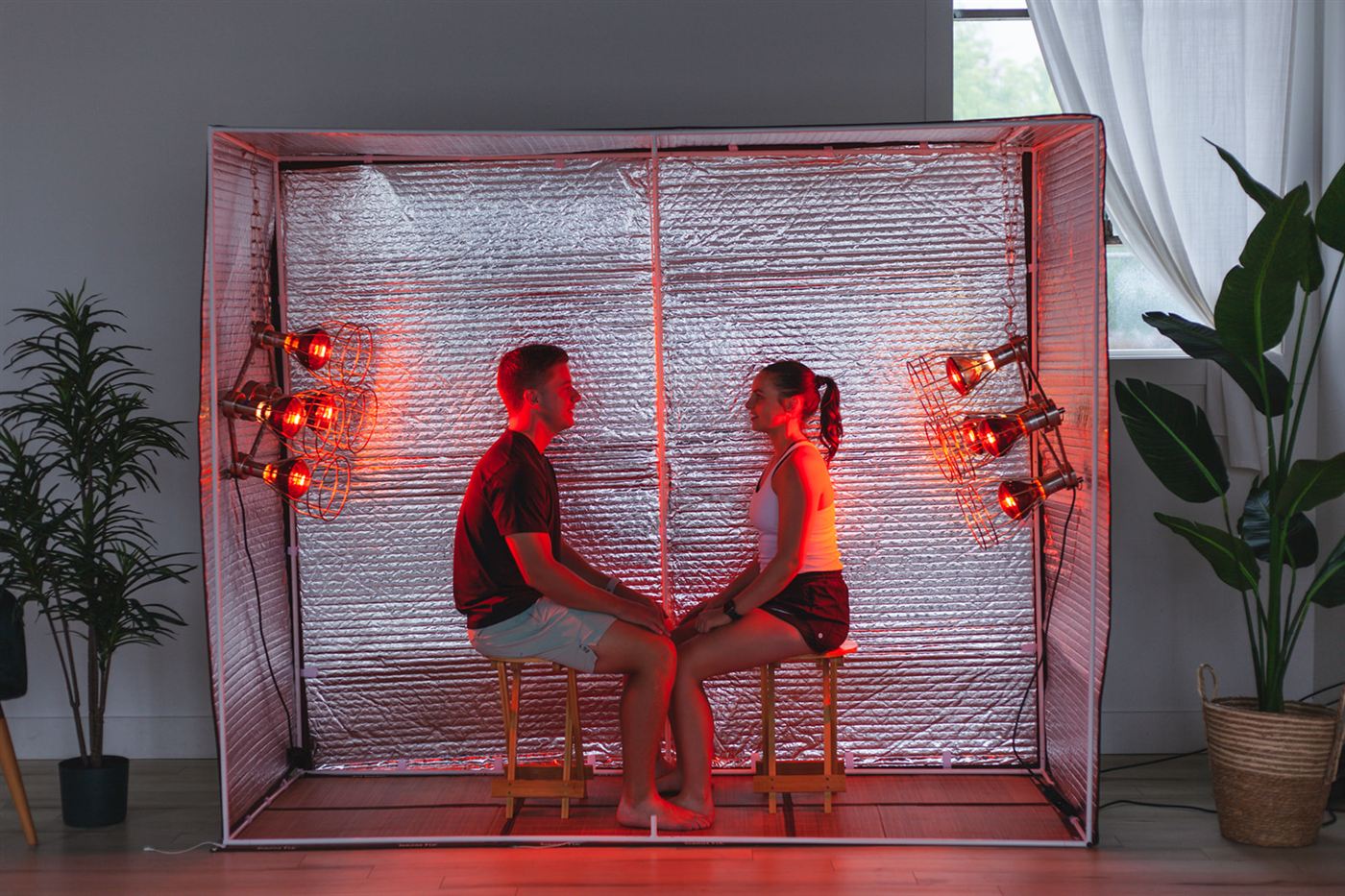
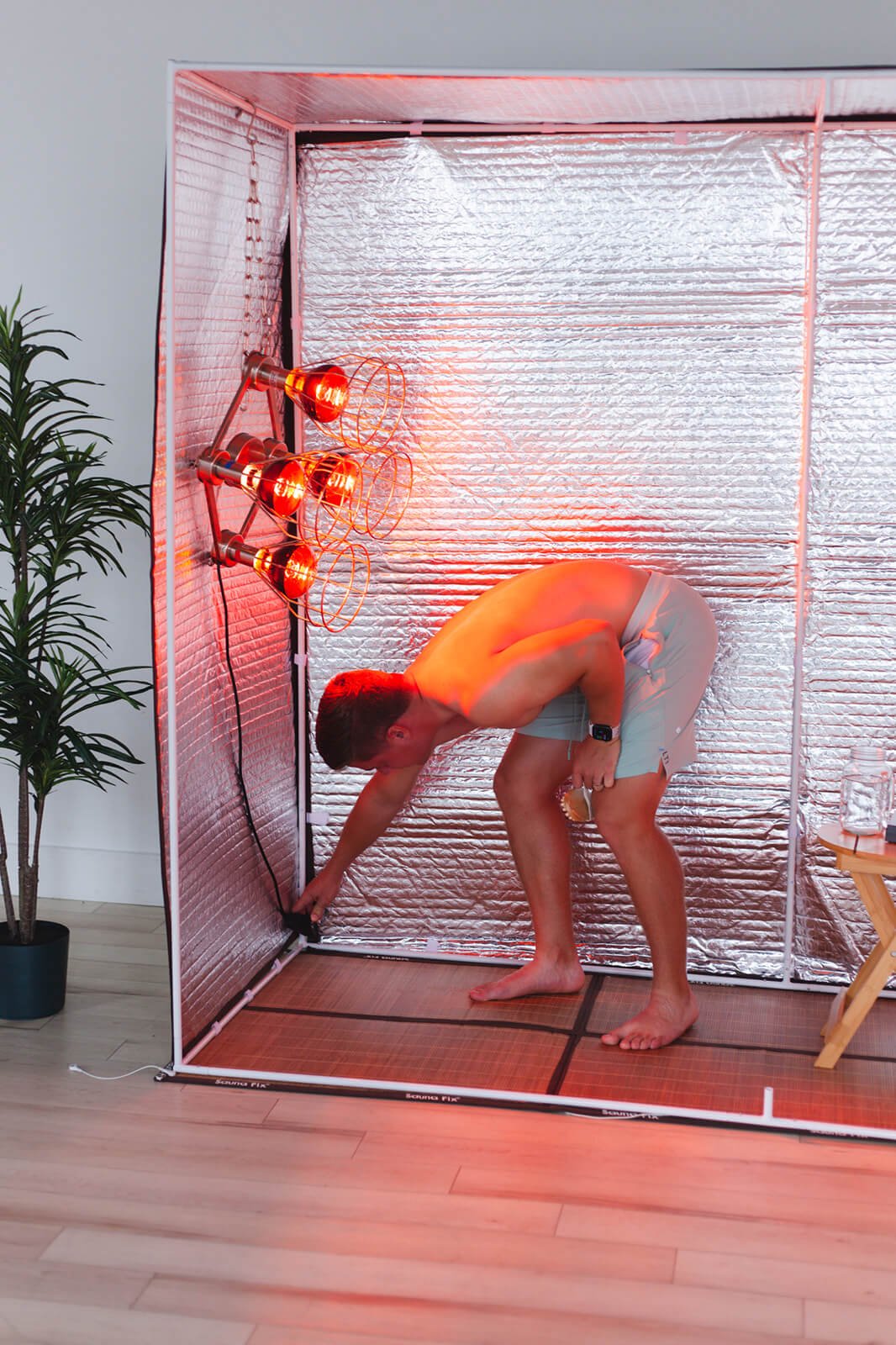
A traditional sauna heats the air to extreme temperatures and waits for that heat to soak inward. A near infrared lamp sauna works in the opposite direction: the light penetrates first and the warmth builds from inside the tissue outward. That is why NIR sessions stay comfortable at 110–140°F — temperatures accessible even to people with heat sensitivity or fatigue — while still producing a deep, productive sweat.
There is a practical bonus, too. Because the lamps heat one side of the body at a time, rotating during a session creates a circulation effect: blood shifts toward the heated side, then redistributes as you turn. That rhythmic shunting moves oxygen and nutrients through deep tissue in a way uniform ambient heat cannot.
What an Accredited Lab Measured on the Sauna Fix Bulb
Here is where I can share something you will not find in a generic article, because it comes from my own product files. When I developed the Sauna Fix® system, I sent the 250-watt bulb to an ILAC-accredited laboratory for spectral testing under EN 62471, the international photobiological safety standard for lamps. The lab measured the bulb’s output across the full 380–3,000 nanometer window and plotted the entire emission curve.
The results shaped how I think about “full spectrum.” The bulb’s meaningful output begins around 550 nanometers — visible red — climbs through the near infrared range where most of its energy is concentrated, and continues through mid-infrared. And at 3,000 nanometers, the edge of the test’s measurement window, the curve was still above zero: the emission does not stop where the instrument stops. The characteristic dips near 1,400 and 1,900 nanometers — water-vapor absorption bands — are visible in the plot, exactly where physics says they should be.
Why does this matter to you? Because “near infrared sauna” is a label anyone can print, and LED products with two or three narrow wavelengths often borrow it. An incandescent heat lamp is a genuinely continuous radiant source — the same physics as sunlight’s warmth — and I publish the full third-party report so you can verify rather than trust. You can review the complete spectral curve, report number and all, in the Sauna Fix Bulb Test Report.
The lab curve is half the story; the other half is what I watch it do in practice. The same spectrum knowledge shapes how I set clients up — distance from the lamps, session length, bare skin toward the light — because an emission curve only matters if the body actually receives it. What clients consistently describe once the setup is right tracks what the physics predicts: warmth that reaches deeper than the skin’s surface, a sweat that arrives earlier at gentler air temperatures, and sessions relaxed enough to repeat most days. I designed the equipment from the measurements, but I calibrate the advice from years of those reports — the laboratory told me what the bulb emits; the people using it taught me what that emission is worth.
Near Infrared Lamps vs. Red Light Panels
People often ask whether an LED red light panel and a near infrared lamp sauna are the same thing. They overlap, but they are built for different jobs. LED panels emit one or a few precise wavelengths at low heat — convenient for targeted, clothed, stand-in-front-of-it sessions. A near infrared lamp sauna combines broad-spectrum light with genuine radiant heat inside a reflective enclosure, so you get the photobiomodulation story and the sweating, circulation, and heat-adaptation story in a single practice.
Neither replaces the other; they answer different needs. If you want a daily whole-body practice that produces a real sweat — the elimination route that first drew you to saunas — the lamp sauna is the tool built for it.
How Long Before You Notice Anything?
Expectations deserve honesty. The first thing almost everyone notices is immediate: the session itself feels good — warming, loosening, quieting. Sleep on sauna days is a common early report. The deeper rewards behave like exercise: they compound with consistency rather than arriving in one dramatic session. Give a new routine several weeks of regular sessions before judging it, and keep the variables honest — hydration, minerals, and reasonable session lengths.
That is also why the habit matters more than the schedule. Whether you choose morning or evening sessions, the version you keep is the version that works.
Building Near Infrared Into Your Routine
- Start short. Fifteen to twenty minutes is plenty at first; build gradually as your body adapts.
- Rotate. Turn every few minutes so each side of the body receives direct light.
- Hydrate and remineralize. Sweat carries minerals out along with toxins — replace both water and electrolytes after each session. A pinch of unrefined salt in your water is the simplest habit.
- Protect your eyes. Never stare into illuminated bulbs; use appropriate protective eyewear during sessions.
- Be consistent. The cellular benefits of near infrared compound with regular use, the same way exercise does.
If you want the deeper science — wavelengths, penetration depths, session protocols, and how NIR fits into a complete wellness routine — the Near Infrared Therapy pillar covers it step by step.
Frequently Asked Questions
Is near infrared light safe?
Near infrared is the same energy family your body receives from sunlight and any warm radiant source, delivered without ultraviolet. Sensible practice keeps it comfortable: moderate session lengths, protective eyewear rather than staring into bulbs, and attention to how your body responds. The Sauna Fix bulb’s photobiological safety testing is published for review.
What is the difference between near, mid, and far infrared?
They are neighboring bands of the same spectrum. Near infrared (roughly 700–1,400 nm) penetrates deepest and interacts with cellular chromophores; mid-infrared is absorbed shallower and contributes warmth; far infrared (beyond 3,000 nm) is primarily surface heat — the band far-infrared panel saunas rely on. An incandescent lamp emits continuously across red, near, and mid-infrared.
Do I need a special room for a near infrared sauna?
No — that was one of my design goals. A radiant tent system sets up in minutes in a bedroom or spare corner, plugs into a standard outlet, and packs away for travel. The reflective enclosure keeps the radiant energy around your body instead of heating the whole room.
Can I exercise or stretch during a session?
In a tent sized for it, yes — combining gentle movement with radiant heat is one of the most productive ways to use a session. The hot exercise sauna configuration exists for exactly that practice.
How often should I take near infrared sessions?
Most people settle into four to six moderate sessions a week. Consistency at a comfortable intensity serves you better than occasional marathon sessions — and your own response is the best guide. If you are pregnant, take medications, or manage a condition affected by heat, your healthcare provider can help you shape a session plan that fits you.
Keep Exploring
- Near Infrared Therapy pillar
- Sauna Fix Bulb Test Report — the full spectral data
- Sauna Fix near infrared saunas
- Free wellness guides
- Benefits of Near Infrared Light Therapy — on Wellness Shopping Online
- Far Infrared vs Near Infrared Saunas: What’s the Difference? — on Wellness Shopping Online
- Can Near-Infrared Light Therapy Promote Healthier Skin? — on Wellness Shopping Online
- Infrared Light Therapy for Arthritis — on Creatrix Solutions
- Near-Infrared Lights – Detoxification — on Creatrix Solutions
- Infrared Light Therapy for Arthritis: An Alternative for Pain Relief — on Wellness Shopping Online
This article is educational — written to help you understand your options and ask better questions. Your healthcare provider can help you apply any of it to your specific situation.