
U.S. patent 10786758, the Water Sterilization System with Multipurpose Degasser, was filed October 2, 2018 and granted September 29, 2020 for a system that mixes ozone into water and removes the undissolved ozone gas before any air leaves the unit. Chapter 4 of my book Invent It and Be Your Own Boss uses it as the example of unique problem-solving, and of a design that replaces the traditional catalyst-bed degassing system.
The Problem the Patent Addresses
Chapter 4 defines the problem in 2 parts: ozone has to be mixed thoroughly with water to sterilize it, and the undissolved ozone gas has to be kept from escaping into the room. Chapter 2 records the testing behind my degassing work. I bought ozone-degassing equipment to recommend to customers who ozonate water, and Chapter 2 records 3 faults in what I tested: the units were fragile, not very portable, and inefficient at dissolving ozone gas into water at high concentrations. To measure the results I bought ozone meters for 2 readings, ambient ozone in the air and dissolved ozone in the water.
The 3 Components in the Abstract
Component 1 is the vortex mixing cylinder, a container with an inlet and an outlet that let the ozone-water mixture flow into a mixing chamber; placing the outlet offset from the inlet helps the cylinder form a homogeneous, ozone-saturated mixture. Component 2 is the endcap, which covers the opening of the mixing chamber and expels gases from it. Component 3 is the deionization system, an electrical filter that removes ozone particles from the air inside the mixing chamber. The deionization system is mounted between the cylinder and the endcap, so every gas leaving the chamber passes through the filter before it is expelled, and the ozone is removed from the gas before discharge.
8 Supporting Features in the Patent Description
Chapter 4 describes 6 further items, which split into 8 features. Feature 1 is the set of mixing elements: textured spheres of non-conductive material with evenly spaced dimples, which create a turbulent current in the chamber. Feature 2 is the vortex-inducing basket, which sits below the surface of the ozone-water mixture, holds the spheres, and has holes and channels that form a vortex. Feature 3 is the pair of threaded inlet and outlet connectors for attaching external fluid lines. Feature 4 is an alternative embodiment that caps the side inlet and outlet and uses a bottom inlet to remove ozone gas.
Feature 5 is the degassing mode: with the basket and the mixing elements removed and a valve and plugs fitted, the same system controls gas flow and works as a degasser; Chapter 4 states that the system can be adapted for degassing applications. Feature 6 is a relief valve that stops over-pressurization. Feature 7 is a conductive liner that supports the removal of undissolved gases. Feature 8 is a window in the cylinder body for visual inspection of the chamber, used for water level control, venting, monitoring and maintenance.
4 Problems With Catalyst-Bed Degassing
Chapter 4 calls the patent a disruptive technology because it removes the need for a traditional catalyst-bed degassing system, and it lists 4 problems with that system. Problem 1 is moisture: the bed material gets wet from moisture in the gas or the environment, and wet material impairs efficiency. Problem 2 is heating and drying: a wet catalyst bed stops working, so it has to be heated and dried, which takes energy and causes downtime. Problem 3 is ongoing maintenance: heating, drying and replacing spent material add operating cost and require labor-intensive monitoring. Problem 4 is equipment cost: catalyst-bed systems use complex setups with expensive components, so both the initial and the ongoing outlay are high. The deionization system in patent 10786758 is an electrical filter that removes undissolved ozone gas from the air exiting the mixing chamber.
Where the Inventive Step Sits
A patent requires an inventive step that a person skilled in the field would not find obvious. Chapter 4 places the inventive step of patent 10786758 in the combination: 1 vortex mixing cylinder, 1 deionization system and the specialized mixing elements, in 1 framework with the relief valve, the conductive liner and the other safety features. Chapter 4 also states the next stage for this invention: its practical applications are to be validated through prototyping, potentially funded by a grant, with tests of how efficiently and safely the system produces ozone-water mixtures. Chapter 9 covers the National Science Foundation grants that can fund that kind of research and development, including the 3 registrations, on SBIR.gov, Research.gov and Sam.gov, required before a proposal.
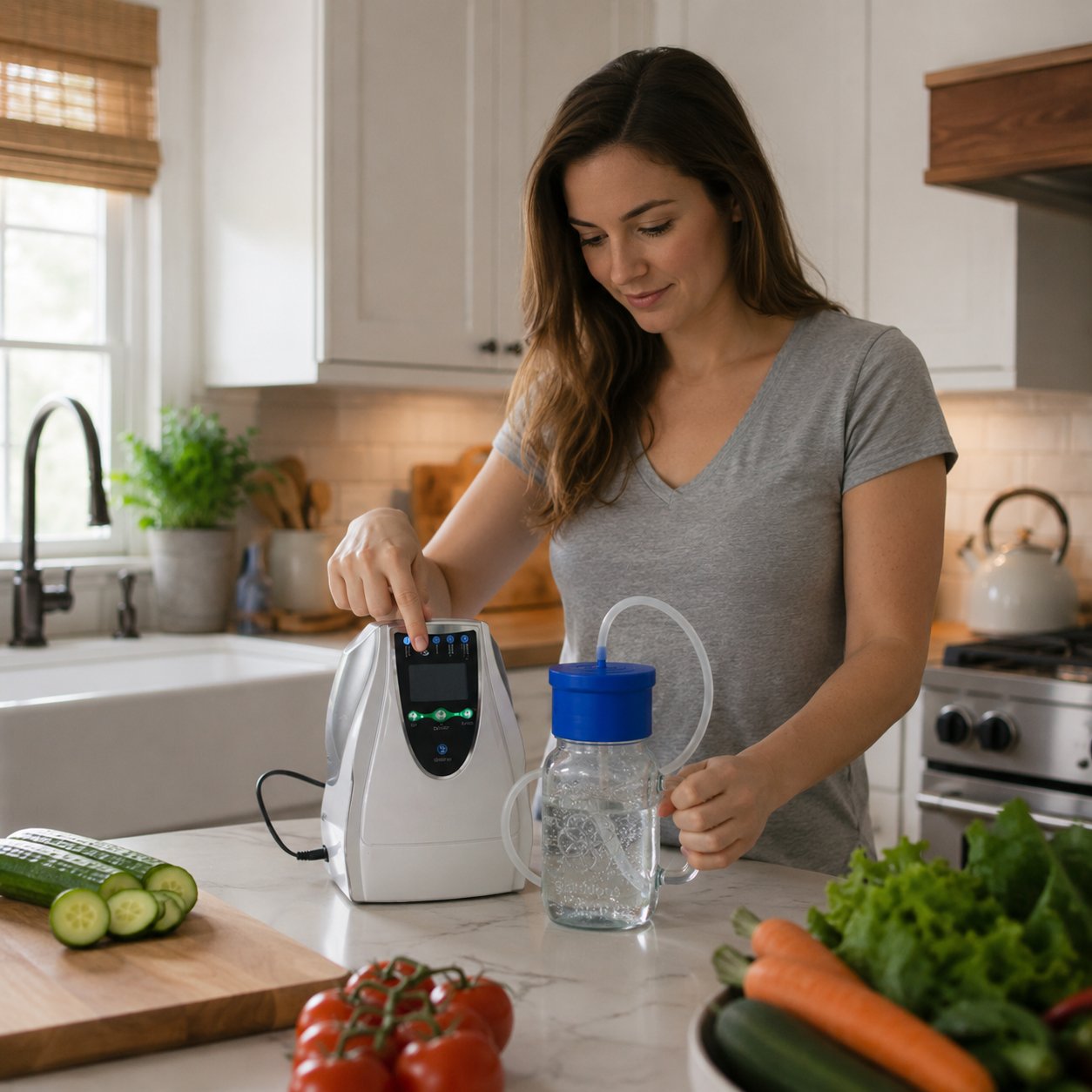
Chapter 2 gives the context for ozone in water work: in cities such as Los Angeles, treatment facilities use ozone to purify sewage, and the method controls 3 variables, ambient ozone levels, liquid-phase ozone concentration and exposure time, to eliminate harmful pathogens through oxidation. My ozone water equipment, including the Tri-Oxy Refresh countertop degasser, is sold under the Tri-Oxy brand.
Keep Exploring
This article is for educational purposes only.