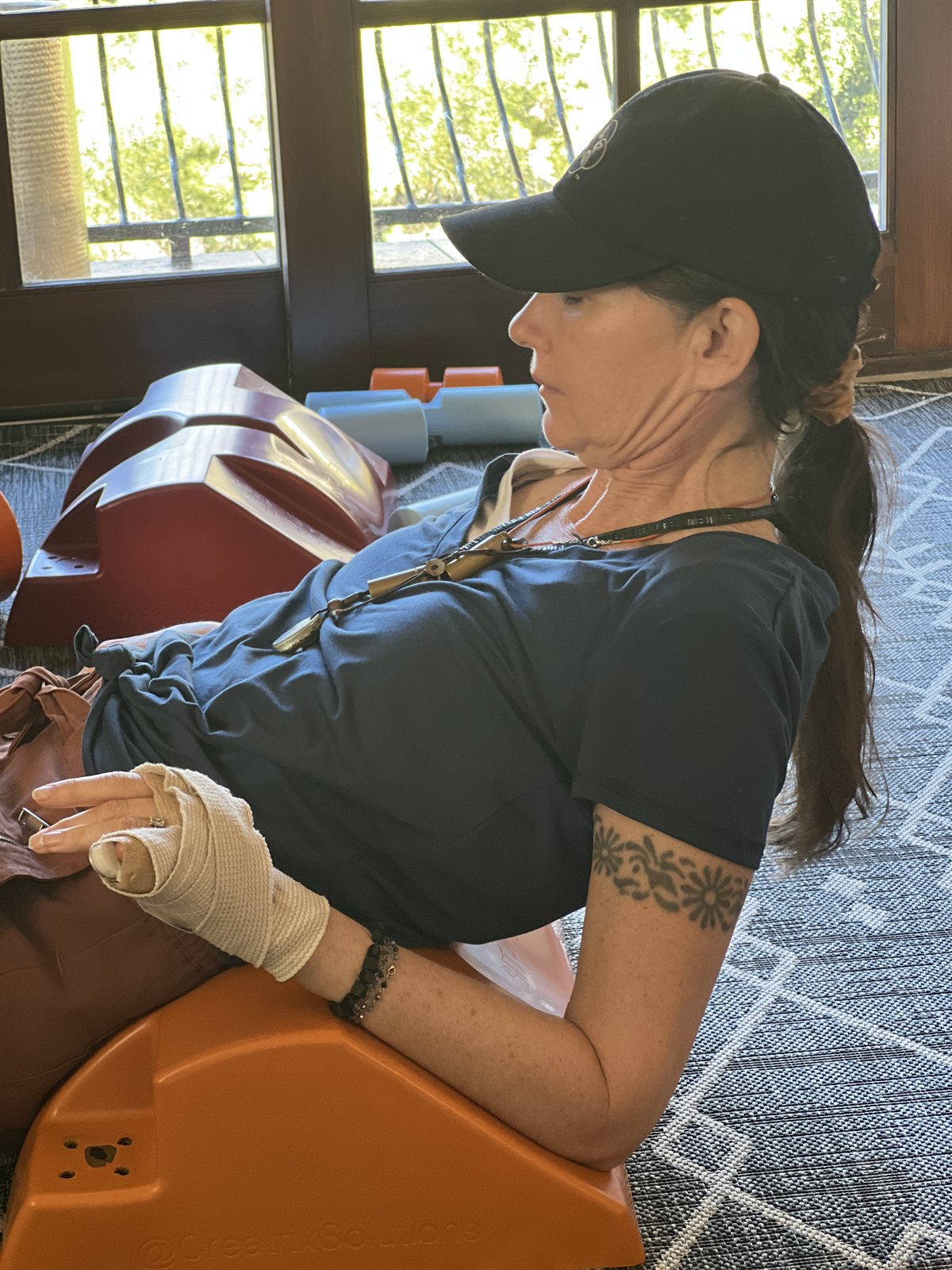

A U.S. utility patent protects how an invention functions for 20 years from its filing date; a design patent protects only its ornamental appearance for 15 years from the grant date. The patent number on a wellness product shows which of the 2 it carries: my Back Roller, sold as the Back Trac foam roller, is design patent D915613, and my Plasma Air Purifier, sold as the Breathe Safe, is utility patent 10881757. Chapter 5 of my book Invent It and Be Your Own Boss sets out both terms.
What the Patent Office Examines
Chapter 4 of the book lists the 3 criteria the USPTO applies: the invention must be novel, non-obvious and useful. Non-obviousness is judged against a hypothetical skilled person with average knowledge of the field, and the usefulness criterion in Chapter 4 requires an invention that functions as intended, shown through prototypes, experiments or simulations. A granted utility patent gives the holder the exclusive right to make, use, sell and import the invention for its 20-year term.
Chapter 5 explains that the claims define the legal boundaries of a patent, while the abstract is a summary of the invention. A design patent’s scope ends at appearance, so under Chapter 5 a competitor can sell a product that performs the same function if it looks different. A provisional application gives “patent pending” status for 12 months with no enforceable rights, so “patent pending” on a box describes a filed application rather than a granted patent.
Sauna Fix: 2 U.S. Patents and 3 Foreign Grants
The Portable Radiant Exercise and Sauna Tent, patent 10010477, was filed September 5, 2017 and granted July 13, 2018. The System for Transporting a Sauna Device, patent 10449113, covers the sealable carrying bag that stores and transports the infrared sauna lamp; it was filed June 28, 2016 and granted October 22, 2019. The sauna patents protect the products sold together as Sauna Fix, and the sauna tent is also patented in Canada, China and Australia.
To check patent 10010477 against a product, compare its abstract with the unit: it describes scaffolding that defines a thermal zone around the user, a thermally insulative cover with 2 panels and an overlay panel, at least 1 heating lamp, lateral posts adjustable in length, and a size and shape that adjust to the user’s position. The convertible Sauna Fix tent, which moves between sitting and lying positions on brackets, is the product built on that abstract.
The design decisions behind those claims are recorded in Chapter 3. Early near-infrared sauna tents used canvas covers that held little heat and wrinkled, shrank and sagged after repeated washing, and the wood used in saunas contains pitch that releases volatile organic compounds when heated. I chose foil insulation panels and changed the bubble size of the panel material to raise its insulation value from R4.5 to R15. Tent sizes run from 4 x 4 x 5 feet to 3 x 4 feet x 6 feet 5 inches; the exercise size is 3 feet x 6 feet 5 inches x 7 feet 11 inches, with bamboo mats over radiant insulation and a drop ceiling for temperature control.
The patent covers the design, and the testing is published as a separate document: Creatrix Solutions posts the Sauna Fix bulb safety test report under the EN 62471 standard. A buyer comparing heat lamp saunas can ask any maker for the equivalent report with its standard named.
Breathe Safe: A Patent for a Combination
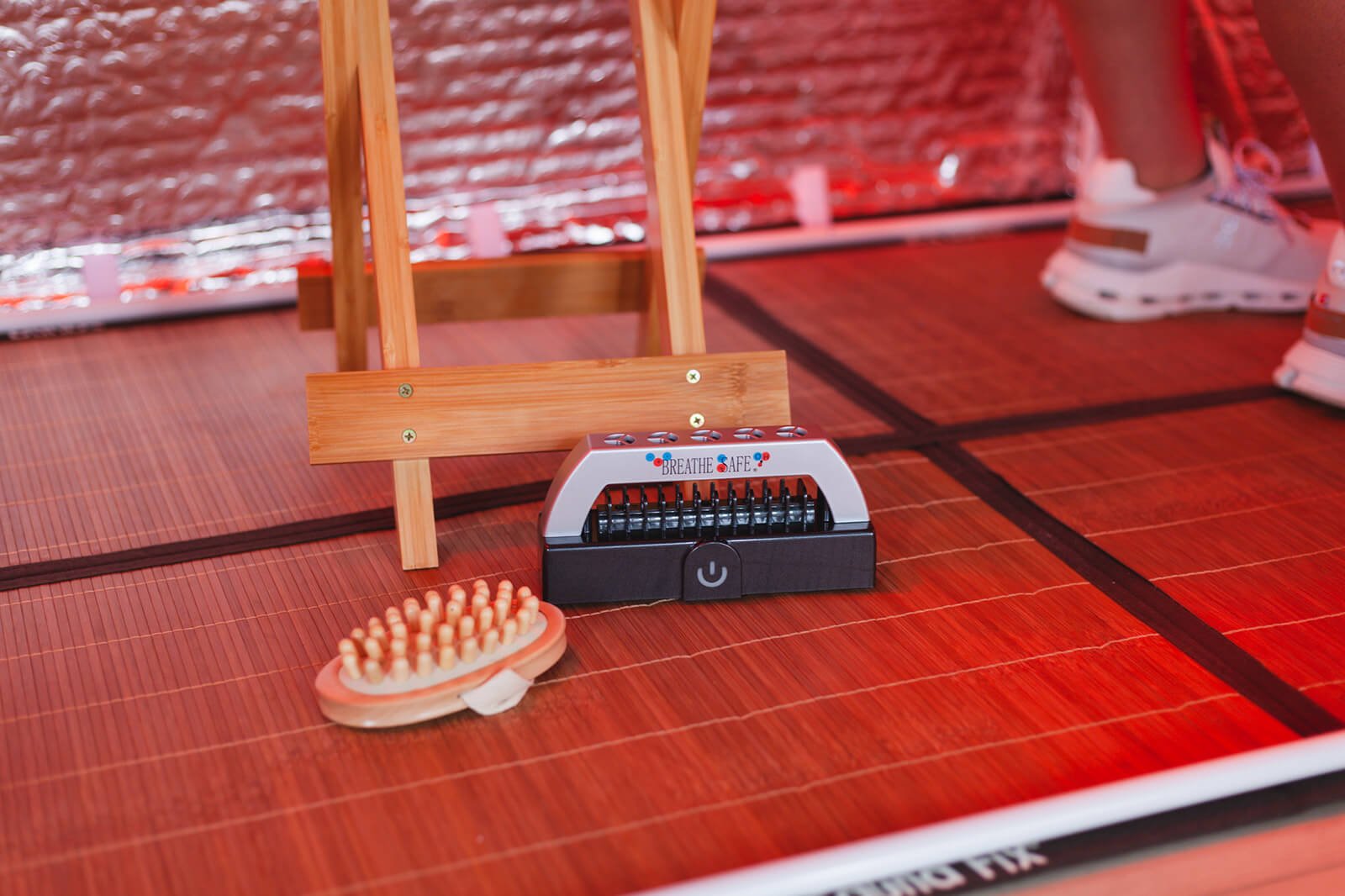
Patent 10881757 for the Plasma Air Purifier was filed January 11, 2018 and granted January 5, 2021, with patents also granted in China, Canada and Australia. Its abstract describes a housing, a discharge plate that produces negative ions, a discharge needle array that produces positive ions, a microcontroller and a power supply. Chapter 4 of the book uses it as the example of a unique combination: the individual elements are known, and their arrangement and interaction in 1 portable air purifier made the invention patentable.
A customer who measured ambient ozone at work showed me that corona-discharge ozone generators emitted unsafe levels almost immediately, and my first-generation REION exceeded acceptable limits on its plasma setting within a 5-foot radius. I designed the Breathe Safe as a plasma air purifier with no ozone emission, then tested its negative and positive ion output and its reduction of volatile organic compounds, particles and bacteria in the air. Chapter 2 classifies the Breathe Safe as a personal space air purifier and limits its claim to air purification, and Creatrix Solutions publishes its laboratory test results.
Spinal Fitness Rolls: Utility and Design Patents Together
The Cushioning Posterior Fulcrum Back Shaper, utility patent 10966552, was filed as a U.S. utility application on March 28, 2019 and granted April 6, 2021. Its abstract describes a back shaper with a semicircular prismatic body that supports the arch of the back, a recess that supports the sacrum and a recess that supports the pelvis, and a neck shaper rotatably mounted to it with 2 interlocking arms and a grooved channel that positions the spine. The written opinion of the International Searching Authority, issued December 26, 2017, accepted its novelty and industrial applicability and found no inventive step over prior art; I added features and functions, and my attorneys filed a PCT continuation-in-part and the utility application that became patent 10966552.
Three design patents cover the roll shapes: the Back Roll Spinal Brace, D859668, granted September 10, 2019; the Neck Roll Spinal Brace, D858779, granted September 3, 2019; and the Back Roller, D915613, granted April 6, 2021. The roll groove supports the transverse processes of the vertebrae while the spinous process floats. Back Shaper rolls come in 5 diameters and 3 densities at 12 inches long, and Neck Shaper rolls come in 5 diameters and 3 densities at 7 inches long.
A Buyer’s Checklist From the Patent Record
- Find the number and its type. A design patent number begins with D, as in D915613; a utility patent number has no letter prefix, as in 10881757.
- Check granted against pending. A provisional application gives patent-pending status for 12 months and no enforceable rights.
- Read the abstract and the claims against the product in front of you, feature by feature.
- Note the dates. Utility protection runs 20 years from filing, design protection 15 years from grant, and maintenance fees keep a patent active.
- Ask for the test report that sits beside the patent, with the standard named, such as EN 62471 for the Sauna Fix bulb.
- Read the maker’s own statement of what the product is for, and compare it with the claim language.
From Eileen
I hold 10 U.S. patents and 6 international patents and have commercialized 9 of the 10 U.S. patents; women hold 13% of patents worldwide, and 85% of patents never reach commercialization. The patent documents and figures are posted on EileenDurfee.com, and Chapter 2 of my book states the standard I keep for my own products: well-documented test results and genuine customer feedback, presented transparently, so a buyer can review them and decide whether the product meets their needs.
Keep Exploring
This article is for educational purposes only and is not medical advice. Patent information here is general education; a registered patent attorney can answer questions about a specific patent.