
The Action Workbook that accompanies my book Invent It and Be Your Own Boss divides inventor coaching into 20 planning sections and 8 bonus tools, from Section 1, Your Inventor Mindset, to Section 20, Your 90-Day Inventor Action Plan. I wrote both from my own record: 10 U.S. patents and 6 international patents, with 9 of the 10 U.S. patents commercialized. Women hold 13% of patents worldwide, and 85% of patents never reach commercialization. Sections 2, 3 and 16 through 19 cover the customer and the sale; Sections 5 through 15 cover originality, protection, prototypes, the patent process and cost.
Sections 2 and 3: The Problem and the Customer
Section 2 asks the entrepreneur to state the problem in 1 sentence, then record who has it, where it happens, how often it happens, what people do to work around it, and what an ideal solution would need to do. The Section 2 tip states that a strong invention usually solves a real problem rather than a minor preference.
Section 3 holds 3 deep customer interview cards, each recording the customer’s problem, current solution, biggest frustration and the product they wish existed, followed by a quick interview log for spotting the pattern across conversations. Chapter 1 of the book calls consumer focus groups essential because several users evaluating 1 idea surface improvements that a single inventor misses. Chapter 3 adds the lean startup approach, in which in-depth interviews and surveys test the need before a substantial investment.
My sauna tent once measured 4 feet by 4 feet by 5 feet tall, and the user crawled in and sat on a stool; 1 customer turned it on its side, with the floor against the wall, and laid it diagonally. That observation became the convertible Sauna Fix tent, with brackets that switch it between sitting and lying for a person up to 6 feet 5 inches tall. Another customer with back and leg pain took coffee enemas standing up and rolled the bag to move the fluid, and I designed the Enema Fix: a glass jar, adapter and pump assembly with long tubing, used standing in the shower.
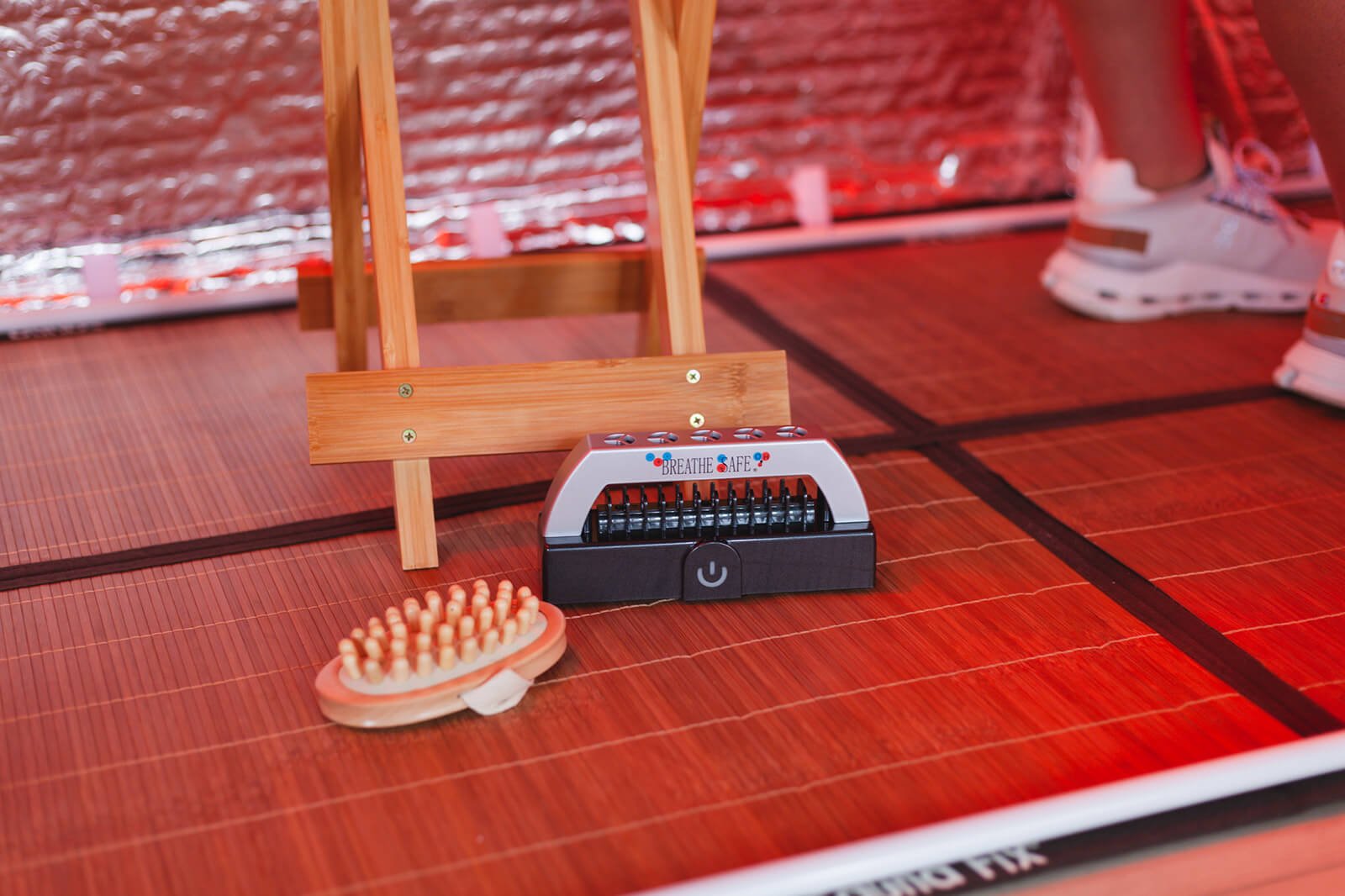
A third customer measured ambient ozone at work and showed me that corona-discharge ozone generators emitted unsafe levels almost immediately; my first-generation REION exceeded acceptable limits on its plasma setting within a 5-foot radius. I rewrote the REION owner’s manual, then designed the Breathe Safe plasma air purifier with no ozone emission and the Tri-Oxy Refresh ozone degasser. For the Refresh I hired a draftsman through Upwork, bought a Formlabs 3D printer, and bought ozone meters to measure ambient ozone in the room and dissolved ozone in the water.
Sections 4, 9 and 10: Concept, Prototype and Proof
Section 4 asks for an explanation of the solution simple enough for someone outside the industry to follow, with a page for sketches. Section 9 plans the first prototype around 1 rule from its tip: the first version must teach something useful, and it can be rough. The Section 9 questions cover whether the build needs CAD drawings or 3D printing, and whether it needs a seamstress, machinist, engineer, mold maker, chemist, programmer, manufacturer or designer.
Section 10, Testing and Proof, turns claims into measurements: what the invention must prove, which safety issues need testing, which performance claims need evidence, what instruments are needed, and what counts as success or failure. Bonus Tool 5, the Prototype Testing Log, records each version, the question its test answered, and the change planned for the next version. Chapter 1 of the book budgets for this stage: each prototype may cost more than the last, and each failed prototype carries the information for the next.
For the Breathe Safe I tested the plasma output, both negative and positive ions, and measured its reduction of volatile organic compounds, particles and bacteria in the air. Chapter 2 of the book states the standard I apply to every product: well-documented test results and genuine customer feedback, presented transparently, so a buyer can review them and decide whether the product meets their needs.
Sections 5 Through 15: Originality, Protection and Cost
Sections 5 through 15 follow the patent chapters of the book. Section 5 and Bonus Tool 4 log prior art searches; Section 6 checks the 3 criteria of novelty, non-obviousness and usefulness; Section 7 and Bonus Tool 2 plan confidentiality and NDAs before any meeting; Section 8 is the inventor’s notebook. Sections 11 through 14 cover the patent pathway decision, the patent attorney, application preparation and office actions, and Bonus Tool 3 prepares the attorney call.
Two deadlines from the book apply to these sections: public disclosure of an invention for more than 1 year before filing can cost the patent, and a provisional application holds its filing date for 12 months. Section 15, Cost and Funding Strategy, lists the budget lines from prior art searches, attorney fees, filing fees and testing to manufacturing, packaging and launch, and it asks which expenses to track as possible R&D documentation for a CPA. All but 3 of my patent grants had rejected claims that were argued and revised before issue, and I borrowed money to pay those response fees and keep the applications alive.
Sections 16 and 17: Choosing the Path to Market
Section 16 opens with the tip that a patent is only the beginning and a successful invention needs a realistic path to customers. Its 9 questions cover the route, whether licensing, manufacturing, selling direct, wholesale, partnering, certifying others or building a business around the invention, along with the first buyer, the sales channel, the price range and the proof buyers will need.
Section 17 weighs the 4 routes it lists, which are to own and sell the product, license it to another company, sell the patent, or partner; its tip names the tradeoffs as control, cost, risk, revenue potential and personal goals. I built from the customers I already served: I started a small business with a diploma in Nutritional Balancing Science using hair tissue mineral analysis lab testing, designed equipment to solve the problems my clients met, and kept 100% ownership of my company. I plan to license 2 of my patents.
Sections 18 and 19: Positioning and Proof of Impact
Section 18 sets the positioning: the product name and what it communicates, the problem it solves, what makes it different, the proof behind the message, and the claims to hold back until they are supported. Section 19 plans beta-tester questions and testimonial collection, and asks what evidence can be used ethically and accurately. For a wellness product, Sections 18 and 19 hold the claims discipline: the book describes the Breathe Safe as a personal space air purifier and limits its claim to air purification.
Bonus Tool 1 and Section 20: Readiness and the 90-Day Plan
The Inventor Readiness Scorecard rates 7 items from 1 to 5, each with a written reason: clarity of the problem, originality after initial research, real-life usefulness, market demand, readiness to prototype, readiness to discuss patent strategy, and realism of the commercialization path; its tip states that the scores show where the idea is strong and where it needs more work.
Section 20 sets the dates: the most important next step, then what must happen within 7, 30, 60 and 90 days, who can help, and what the cost of doing nothing is. Bonus Tool 7, the Commercialization Roadmap, places the path from idea to market on 1 page, and Bonus Tool 8 is the Final Inventor Commitment Page.
Where the Coaching Comes From
Chapter 10 of the book records that I share what I have learned through speaking, coaching programs and educational resources, and that guiding fellow inventors, particularly women, is a personal mission. Chapter 1 sets the terms for that mentoring: some women who sought advice from men have had their ideas taken, so non-disclosure agreements are the norm, and women mentoring women is the model the book proposes.
Keep Exploring
This article is for educational purposes only and is not medical advice. The workbook is planning material and is not legal, patent, tax, financial or business advice; consult qualified professionals before filing patents, sharing confidential ideas, claiming tax credits or applying for grants.