
A posture correction device review should begin with one honest question: does the device teach your body to move better, or does it simply hold you in a position for a few hours? That distinction matters when neck tension, rounded shoulders, stiffness, and forward head posture have become part of everyday life. A tool can provide a valuable reminder, but lasting posture change requires the muscles, joints, breathing patterns, and daily habits behind your alignment to participate.
For adults who want to age with strength and energy, the best posture device is rarely the one that pulls hardest or promises the fastest change. It is the one you can use consistently, safely, and intelligently as part of a broader spinal fitness plan.
What a Posture Correction Device Can Actually Do
Posture devices work in several different ways. Some provide a light physical cue when the shoulders drift forward. Others place the body in a supported position that encourages extension through the upper back. A few are designed to improve awareness while you exercise or work at a desk.
Used well, these tools can help interrupt a familiar pattern. Many people do not realize how far the head has moved in front of the shoulders until they feel a gentle reminder. This awareness can make it easier to adjust a workstation, change a phone habit, take movement breaks, and begin rebuilding better movement patterns.
What a device cannot do is replace movement, strength, mobility, recovery, or professional evaluation when symptoms are severe or persistent. Posture is not a statue-like position to force and hold. It is the ability to adapt, breathe, reach, walk, rotate, and return to natural alignment with less unnecessary strain.
Posture Correction Device Review: The Main Categories
The right category depends on what is contributing to your posture pattern. A person who collapses forward after long computer sessions may need a different solution than someone with a very stiff upper back, reduced shoulder mobility, or poor body awareness during exercise.
Wearable posture braces and straps
Traditional posture braces generally loop around the shoulders and upper torso, encouraging the shoulders to stay farther back. Their greatest value is often behavioral. A light, comfortable brace can remind you when you are slumping at a computer, driving, or standing in line.
The trade-off is that a brace can become a crutch if it is worn too tightly or for too long. If the straps do all the work, your postural muscles are not being asked to learn the job. Aggressive pulling can also feel restrictive around the chest and shoulders, particularly for people who already have limited mobility.
Look for adjustable straps, breathable material, and a design that provides a cue rather than rigid immobilization. Start with brief wear periods. Use the reminder to reset your body: gently lengthen through the spine, let the ribs stack over the pelvis, relax the jaw, and breathe into the sides and back of the rib cage.
Electronic posture trainers
Small wearable sensors may vibrate when your upper body moves beyond a selected angle. These devices can be useful for people who respond well to data and feedback. They are less visible under clothing than many braces, and they can make an unconscious slouch more noticeable.
However, a sensor measures position, not the whole story. Leaning forward to garden, lift groceries, or work on a project is not automatically poor posture. A quality device should help you recognize prolonged, habitual positions, not make you afraid of normal movement.
Electronic trainers also require charging, calibration, and realistic expectations. If the alert becomes constant, many users simply tune it out. The best setting is usually one that encourages awareness without interrupting every normal activity.
Spinal fitness and positioning tools
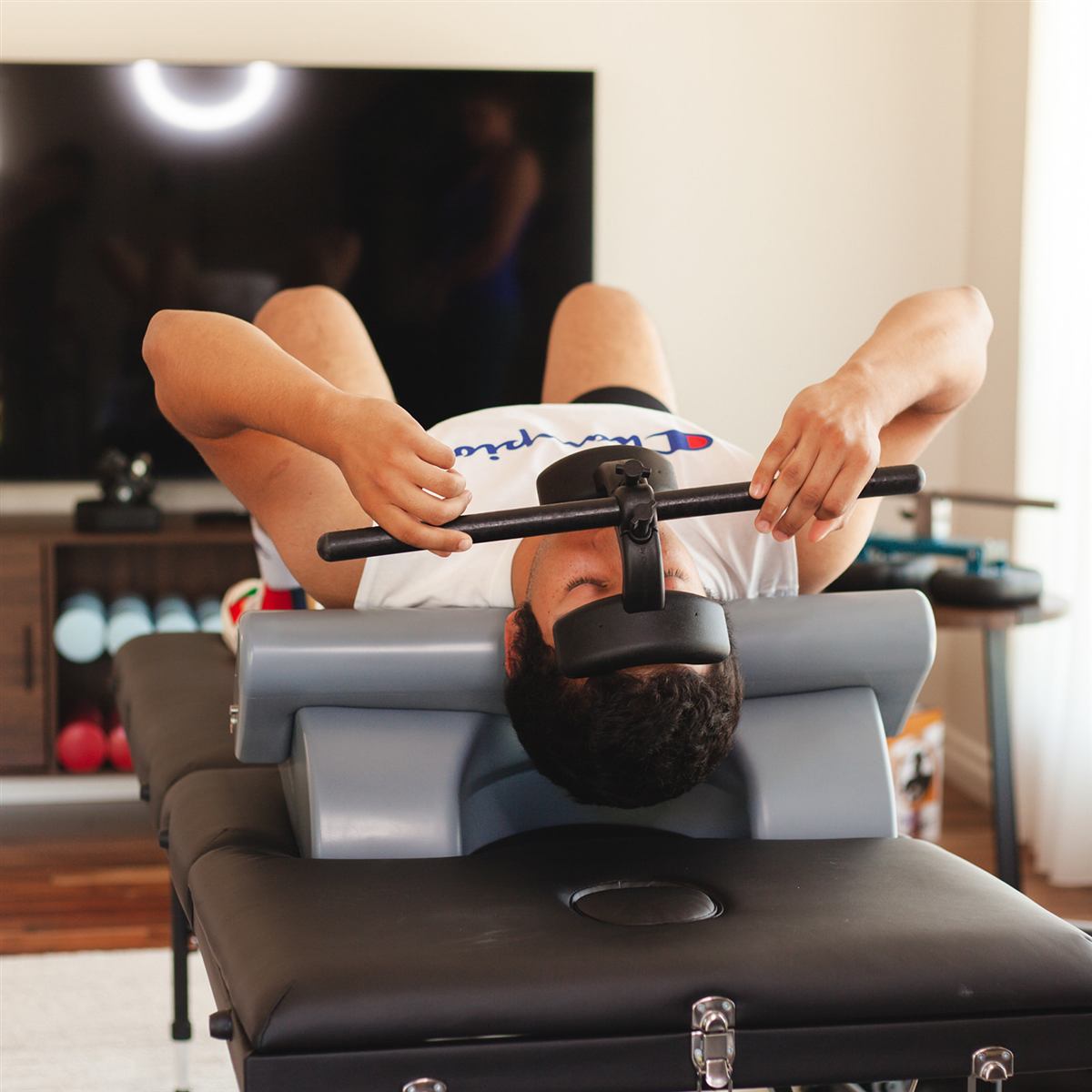
This category is often more useful for people who want to address the source of stress on the body rather than only pull the shoulders back. Spinal fitness tools may support gentle extension, help open the front of the chest, or create a more comfortable position for practicing alignment and controlled movement.
A tool such as a neck support or back extension device should never be selected just because it looks intense. The design, angle, amount of support, and your own starting mobility all matter. More pressure is not necessarily better. The goal is to restore better function through gradual, repeatable practice.
Patented spinal fitness tools, including options such as the Neck Shaper Kit and Back Trac available through Creatrix Solutions, are intended to support practical at-home posture work. They make the most sense when used as part of a routine that includes walking, strengthening, mobility work, hydration, adequate recovery, and attention to the way you sit and sleep.
The Review Criteria That Matter More Than Marketing
It is easy to be impressed by dramatic before-and-after photos. A more useful review examines whether a device fits real life. Before buying, consider comfort, adjustability, ease of use, and whether the tool supports active participation rather than passive dependence.
Comfort is not a minor detail. A device that pinches, overheats, rolls up, or limits breathing will stay in a drawer. For middle-aged and older adults especially, a tool should be easy to put on, easy to clean, and manageable without complex setup.
Also consider whether the device matches your goal. If your main issue is desk slumping, a simple wearable cue plus workstation changes may be enough. If your upper back feels locked and your shoulders lack range of motion, a spinal fitness approach may be more appropriate. If pain follows an injury, surgery, numbness, weakness, balance changes, or significant loss of function, get individualized guidance before trying to self-correct with any device.
Why Pulling the Shoulders Back Is Not Enough
The popular image of good posture is military: chest up, shoulders back, stomach tight. Holding that pose all day can create another kind of tension. Natural alignment is more dynamic. The head should be supported over the torso, the rib cage should move with breathing, and the pelvis should be able to guide the spine as you change positions.
Forward head posture often develops alongside more than weak upper-back muscles. It may reflect long periods of close-up work, restricted chest and shoulder movement, shallow breathing, poor sleep positioning, reduced core and hip strength, or simply fatigue. That is why a single brace can be helpful but incomplete.
The Eileen Durfee Method looks at posture as a foundation for mobility, resilience, recovery, and healthy aging. Instead of chasing a perfect pose, the focus is on combining wellness education with practical tools that help the body move and recover more effectively.
How to Use a Device Without Becoming Dependent on It
Think of your posture tool as a coach, not a cast. Use it for a specific purpose and pair it with active work. A short session before a walk, after computer time, or during gentle mobility practice can reinforce awareness without asking the device to carry the entire load.
When you remove it, practice maintaining the feeling on your own. Stand with your feet grounded, allow the knees to stay soft, and gently lengthen rather than force the chest upward. Move the shoulders slowly, turn the head comfortably side to side, and take several unhurried breaths. These small repetitions teach your nervous system that a more supported position is available.
A simple routine may also include regular walking, light resistance training, upper-back strengthening, chest and hip mobility, and a workstation that keeps screens closer to eye level. If you use a phone frequently, bringing it up rather than dropping your head down can make a meaningful difference over time.
Recovery matters as well. Muscles that are overworked, undernourished, or poorly rested do not adapt as well. Supporting hydration, mineral balance, sleep quality, and sensible recovery practices can help build a stronger foundation for any posture plan. People with ongoing fatigue, cramping, or unusually slow recovery may benefit from discussing broader nutrition and lifestyle support with a qualified professional.
A Better Buying Decision
Choose a posture correction device that is adjustable, comfortable, and aligned with your actual pattern, not just a marketing claim. Begin with low intensity, short sessions, and active movement. Track useful changes such as improved awareness, easier movement, better tolerance for sitting or standing, and greater confidence in your body rather than chasing a flawless appearance.
Your posture is not a failure to fix. It is information from a body adapting to work, stress, injuries, habits, and the passage of time. Give it patient attention, practical support, and opportunities to move well. The right device can be a helpful part of that process, but your daily choices are what turn a temporary reminder into lasting resilience.
The Test I Apply to Every Device I Design
Before anything I make reaches a customer, it has to answer one question: when this device is put away, is the body better than before — or just corrected while it was on? I settled on that test after watching what posture braces actually do to the people wearing them. Strap the shoulders back and the postural muscles get the day off; muscles that get the day off get weaker; weaker muscles need the brace more. The device works perfectly and the body gets worse — a dependency dressed up as a solution.
That is why everything in my posture line is a training tool, not a holding tool. A properly sized roll under the neck or mid-back does not hold you anywhere — it gives the spine a template and lets your own tissue do the adapting, a few minutes a day, until the new shape belongs to you rather than to the equipment. It is the difference between renting posture and owning it. My rule for any purchase, including from me: if the benefit disappears when the device comes off, keep shopping.
Frequently Asked Questions
Do posture braces work at all?
As a short-term reminder, they can interrupt a slumping habit; as a solution, they backfire — holding the position for you is exactly what lets your postural muscles weaken. If you use one, use it briefly and deliberately, paired with training that makes it unnecessary.
What about posture apps and vibration reminders?
They address awareness, which is genuinely half the problem — but awareness without capacity just means being reminded of a position your body cannot comfortably hold. Pair any reminder with curve-restoring work, so the position it nags you into becomes easy to keep.
How do I know what size roll or tool my spine needs?
By your body’s response, not a universal chart: the right diameter lets you fully relax over the tool and feel a gentle opening, not a fight. Body size, curve loss, and sensitivity all matter, which is why sizing options exist rather than one-size-fits-all.
How long until a training-based device shows results?
Sessions feel good immediately; noticeable postural change typically takes weeks of daily minutes, and structural change is a months-long project. That timeline is a feature — it is your tissue actually adapting, which is why the result persists when the tool is put away.
Can a device fix posture without any exercise?
No honest device can — posture is held by muscles, and muscles change through use. The good news is how little “exercise” it takes: a few minutes of daily extension work plus ordinary walking beats an hour of gadget-wearing. Tools set the stage; your body does the performing.